Where We Repair Decks Across the Baltimore Metro

Eighteen communities, five counties and Baltimore City — served from Lutherville-Timonium at the I-695 and I-83 interchange.

Service Area

We Repair Decks Across Five Counties and Baltimore City

The Deck Repair Wizard works out of Lutherville-Timonium, where I-695 meets I-83 — which puts Baltimore County's deck-heavy northern suburbs, Howard County, Anne Arundel County, Harford County, Carroll County and the rowhome neighborhoods of Baltimore City all inside a reasonable drive. Below is every community we publish a page for, grouped by county, because in Maryland the county is what decides the rules your repair has to follow.

Baltimore County

Our home county, and the densest concentration of 1980s–2000s decks in the metro.

Lutherville-Timonium

Home base. Housing here is overwhelmingly detached — about 84% in Lutherville and 71% in Timonium — with median build years around 1958 and 1964, meaning most decks were added decades after the house and are now 20 to 40 years old. That's the age where boards are still usable but the ledger, footings and finish start giving out.

Towson

A community of about 59,500 people where only a third of homes are detached, so deck work here is more selective than volume. Neighborhoods like Rodgers Forge and Wiltondale are 1930s–50s brick rowhouse-style blocks where the work is usually porches, steps and patios rather than backyard decks.

Cockeysville & Hunt Valley

Five minutes up I-83 from our base. Detached homes are a minority of the housing stock here, so we work it for proximity — small repairs, board swaps and refinishing jobs are easy for us to schedule around York Road and Padonia Road.

Perry Hall

One of the county's big postwar growth stories: from about 5,400 residents in 1970 to more than 29,000 by 2020, with a median build year of 1986. That makes Perry Hall a prime repair market — a huge cohort of decks all hitting the same 30-plus-year failure window at once.

Kingsville

About 93% detached housing with a median build year of 1976, which is close to ideal for deck repair work. Larger lots and mature tree cover mean shaded, north-facing deck surfaces that hold moisture and grow algae long after the sunny side has dried out.

Catonsville

Roughly half detached homes with a median build year of 1959, sitting on Piedmont hills above the Fall Line with the Patapsco River along the western and southern edge. Sloped lots mean taller decks, taller posts and footings that matter more than they do on flat ground.

Howard County

High-value housing, steep terrain, and the metro's most specific approval process.

Ellicott City

Built across the "seven hills" in the Tiber and Patapsco valleys, which is why so many Ellicott City decks are tall structures over walkout basements rather than low platforms. About half the housing is detached with a median build year of 1989, and heavy valley canopy keeps deck surfaces damp and shaded through the summer.

Columbia

Ten villages, more than 104,000 residents, and roughly 39% detached housing — about 41,000 detached homes, many with original decks from the 1970s and 1980s. Columbia is also the one place in the metro where county permitting is only half the story: every property sits under recorded covenants, and deck work needs an application to the village architectural committee before it starts.

Anne Arundel County

Water everywhere, which is wonderful for the view and hard on wood.

Severna Park

Sitting between the Severn and Magothy Rivers with nearly three of its nineteen square miles under water, Severna Park combines constant humidity with heavy mature canopy. That pairing is why deck finishes here fail early on the shaded side and why we spend as much time on drainage details as on boards.

Arnold

The Broadneck Peninsula, where more than a fifth of the area is water and twelve marinas line the shoreline. Riverside cliffs and sloping wooded lots produce tall, multi-level decks — the kind where post bases, beam connections and stair footings do the real work.

Crofton

A planned community laid out in 1964 on former farmland, so the terrain is flatter than most of our service area and decks sit lower to the ground. Low decks bring their own problem: framing close to grade stays wet longer and needs ground-contact rated lumber where it's within six inches of soil.

Harford & Carroll Counties

The outer edges of the metro, where detached housing rates are the highest we serve.

Bel Air

Harford County's hub, on rolling Piedmont terrain along MD-24 and US-1 Business. The surrounding ZIP codes are where the deck work is — established single-family neighborhoods outside the town limits, built out over decades and now well into repair territory.

Fallston

At about 99% detached housing, Fallston has the highest detached rate anywhere we work, with a median build year of 1977. Large wooded lots, long driveways and 40-year-old decks make it one of the strongest repair markets in the metro.

Eldersburg

Carroll County's largest community, where MD-26 and MD-32 meet, with roughly 82% detached housing and an elevation near 643 feet. Sitting higher and more exposed than the rest of the metro, Eldersburg decks take more wind, more sun and more winter weather than a sheltered valley lot does.

Baltimore City Rowhome Rooftop Decks

A different structure, a different code chapter, and a different way to fail.

Baltimore's rowhomes date from the 1790s through the 1920s, and the rooftop decks on them mostly went up during the 2000s and 2010s renovation wave — which puts them at 10 to 20-plus years old now. A rowhome roof deck typically spans party wall to party wall on shared masonry rather than hanging off a wood ledger, and the first thing to fail is almost never the deck itself. It's the waterproofing membrane underneath it.

Canton

Dense rowhome blocks with one of the highest concentrations of rooftop decks in the city, many now old enough that the membrane below the deck is at the end of its life.

Federal Hill

A CHAP historic district, which means historic approval comes before the building permit and street visibility governs what can be approved at all.

Fells Point

Also a CHAP district, and some of the oldest housing stock in Baltimore — rooftop work here gets reviewed closely and rear-alley visibility matters.

Locust Point

Rowhomes with harbor views, which is exactly why roof decks went up here — and why so many of them now have staining on the ceiling below.

We handle this work as rowhome rooftop deck repair and rooftop deck waterproofing, and the rules are covered in our guide to Baltimore City rooftop deck permits and CHAP approval.
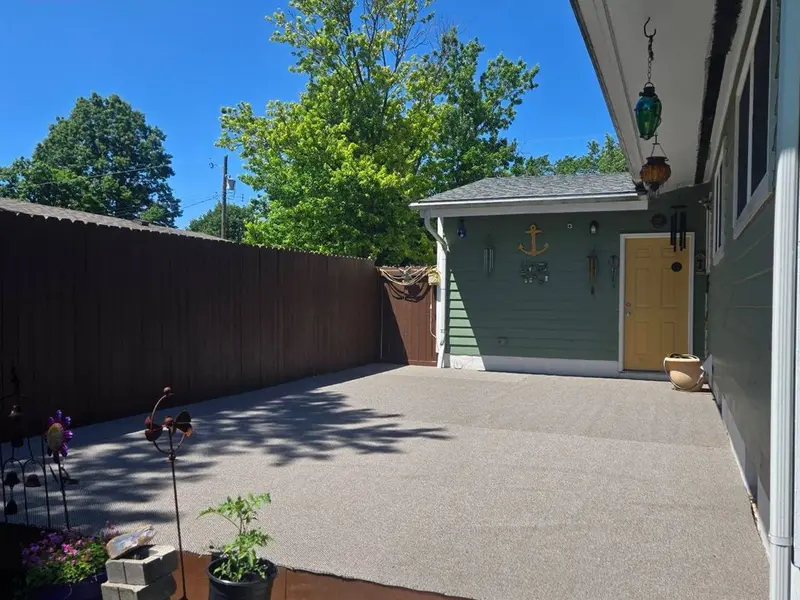
Waterproof coating being applied over a deck surface

Why do permit rules change at every county line?

Because in Maryland each jurisdiction writes its own exemptions on top of the building code — so the same repair can be exempt in one county and require a permit, footing inspection and final inspection ten minutes down the road. This is the single most useful thing we can tell you about working across the Baltimore metro.

What about staining, sealing and power washing?

None of the counties we serve address staining, sealing or power washing in their permit materials — which is not the same thing as a published exemption. We'll tell you exactly which rules apply to your address before any work is scheduled, and we'll say plainly when a repair doesn't trigger a permit at all.

Only Howard and Anne Arundel explicitly exempt board-only replacement, so don't assume the neighbors' experience in another county transfers to yours. If you're comparing, our deck board replacement and structural and rot repair pages explain which kinds of work tend to cross the line, and the cost guide covers what a permitted job adds in time.

Don't See Your Town?

We work the whole Baltimore metro from Lutherville-Timonium. Call and ask — if we cover you, we'll tell you; if we don't, we'll say so.

📞 Call (667) 239-8644 Request a Free Quote
📞 Call Now Free Quote