What is a deck safety inspection, and is it worth doing?
A deck safety inspection is a structured check of every component that holds your deck up, done in the order those components actually fail — the ledger connection first, then framing, posts and footings, hardware, guards and stairs, with the walking surface last. Ours is free, and you walk away with photos and a written punch list whether or not you hire us for anything. If your deck is more than about ten years old and has never been looked at below the boards, it is worth doing this spring.
It's worth doing because the failures that matter are invisible from a deck chair. The industry group NADRA estimates that roughly 30 million of the 60-plus million decks in the United States are past their recommended service life and that fewer than half were built to code. A deck that looks fine and a deck that is fine are two different decks.
Why our inspection is free
Because we only do repairs. A deck builder inspecting your deck has a new deck to sell; a home inspector has a report to sell and no way to fix anything. We want the repair work, so the inspection is how we earn the chance at it — and if the deck turns out to be in good shape, telling you that costs us nothing but a morning.
What we check, in the order decks actually fail
Deck industry and home-inspection groups agree on the ranking: ledger board, beams, support posts, hardware connections, railings, stairs. We work that list.
- 1. The ledger connection. Is it bolted or nailed? Is there continuous flashing at the ledger-to-house joint, as the code requires? Are there lateral load hold-downs — the code calls for 1,500 pounds of tension resistance at each end, either two devices rated 1,500 pounds or more within 24 inches of each deck end or four rated 750 pounds or more, in addition to the ledger bolts. And what is the ledger attached to? The code does not accept cantilevered floor joists, brick or stone veneer, or an engineered I-joist rim without the manufacturer's reinforcement.
- 2. Beam and joists. Probed for rot at the ends and along the top edge, checked for sag, and checked for spans that exceed what the lumber can carry.
- 3. Posts and footings. Post bases probed, standoff checked — the code calls for a one-inch standoff above concrete on weather- and splash-exposed post bases — and footings assessed against the 30-inch frost depth Baltimore County specifies.
- 4. Hardware and fasteners. Joist hangers for correct fasteners and corrosion, bolts for rust streaking. Baltimore County specifies triple-dip galvanized or stainless hardware; ordinary fasteners corrode quickly against modern treated lumber.
- 5. Guards and railings. Every post load-tested by hand, guard height measured against the 36-inch minimum for homes, and openings checked against the 4-inch sphere rule.
- 6. Stairs. Stringer bottoms probed, bearing checked, risers and treads measured against the 7¾-inch maximum rise and 10-inch minimum tread, and handrails checked for the 34-to-38-inch height and graspable profile required at four or more risers.
- 7. Surface and finish. Boards probed top and underside, and a water-bead test on the finish — if water soaks in rather than beading, the deck is absorbing every rain.
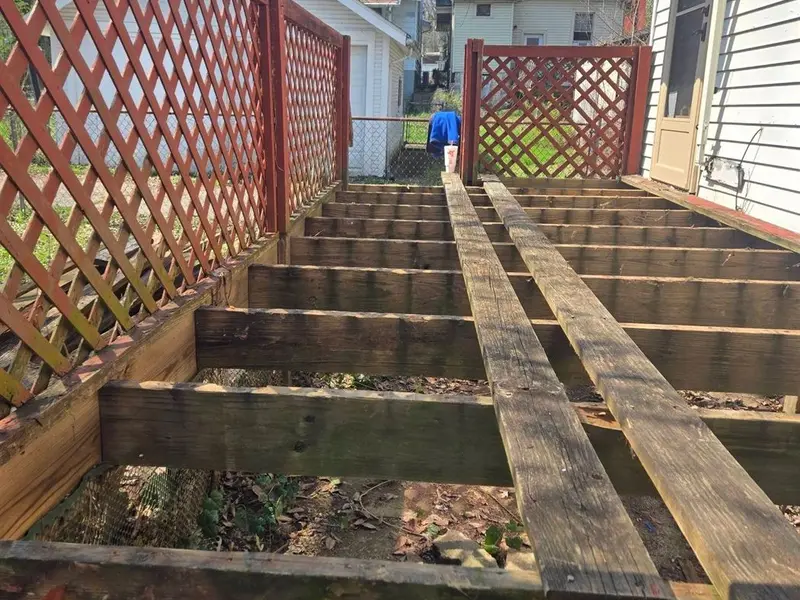
Signs you should book an inspection now rather than in spring
- The deck bounces or sways when you walk on it.
- A gap has opened between the deck and the house, or the siding below the deck is stained or peeling.
- A screwdriver sinks into wood at a post base, a joist end or a stair stringer.
- A railing moves when you lean against it.
- Rust streaks run down from bolts or joist hangers.
- The deck has just been through a serious storm. Maryland recorded 85 billion-dollar disasters between 1980 and 2024 according to NOAA's National Centers for Environmental Information, and recent years have averaged 5.6 such events annually against a long-run average of 1.9.
- You are buying or selling the house and nobody knows how old the deck is or who built it.
- You are about to put a crowd on it. A deck is designed for 40 pounds per square foot of live load — a party concentrates far more than the average.
How a free deck inspection works
- Book it. Call or send the form. Photos help us come prepared, but they aren't required.
- We walk the deck with you. Above and below where access allows, probing rather than eyeballing.
- We photograph the findings. Especially the things you'd never see — the underside of the ledger, the joist ends, the bottom of the stringers.
- Written punch list. Sorted into urgent, schedule-it, and cosmetic, so you know what to act on and what can wait a season.
- Itemized repair quote, if you want one. Including whether your county requires a permit for the scope described.
- Your call. Hire us, hire someone else, or handle the small items yourself. The punch list is yours either way.
Why "deck inspection and repair near me" is the right search
People type that phrase because they have worked out the obvious thing: an inspection you can't act on is half a service. A home inspector hands you a report and leaves. A deck builder inspects and quotes a new deck. Splitting inspection from repair means paying twice for the same diagnosis and waiting through two rounds of scheduling before a single board gets touched.
We do both, and the incentive runs the right way because we don't build new decks. There is nothing for us in telling you the frame is finished when it isn't. When the honest answer is that repairs will cost more than they're worth, we say that too — our guide on whether to repair or replace a deck lays out the exact thresholds we use.
What the inspection leads to
Most punch lists point at one of a handful of repairs. The common ones:
- Deck structural and rot repair — rotted joists, a nailed or unflashed ledger, sagging framing, posts and footings. The highest-stakes item on any list.
- Deck board replacement — soft, cracked or cupped boards, or a full resurface over sound framing.
- Railing repair and code retrofit — loose posts, short guards, and baluster gaps wider than 4 inches.
- Stair and step repair — stringers on soil, uneven bottom risers, missing handrails.
- Staining and sealing — when the water-bead test fails. Water-repellent sealers typically need reapplication every 12 to 18 months, and sometimes every 6 to 12 under heavy sun and traffic.
Costs for those repairs are published only as national averages — there is no Maryland-specific deck pricing data — and we lay all of them out, source by source, in the Baltimore deck repair cost guide so you can sanity-check any quote you're given, including ours.
Where we inspect decks
We're based in Lutherville-Timonium at the I-695 and I-83 interchange, which puts most of the metro's deck-heavy neighborhoods inside a short drive — and the housing stock tells us what to expect before we arrive. Lutherville-Timonium houses date to around 1958 and 1964 with decks added later, so most of what we inspect there is a second-generation addition on an older frame. Fallston is 99.4 percent detached homes with a median build year of 1977. Perry Hall's median build year is 1986, which puts a large share of its decks squarely in the nailed-ledger era. Ellicott City's steep valley lots mean tall decks over walkouts, where a guard or stair defect carries much further to the ground. We also inspect across Towson, Columbia, Severna Park, Crofton, Bel Air and Eldersburg.
Want to do a first pass yourself before booking? Work through our deck safety inspection checklist — it's the same sequence we follow, written so you can do it with a screwdriver and a tape measure. And if your deck dates to the 1980s, start with why decks from that era fail at the ledger.