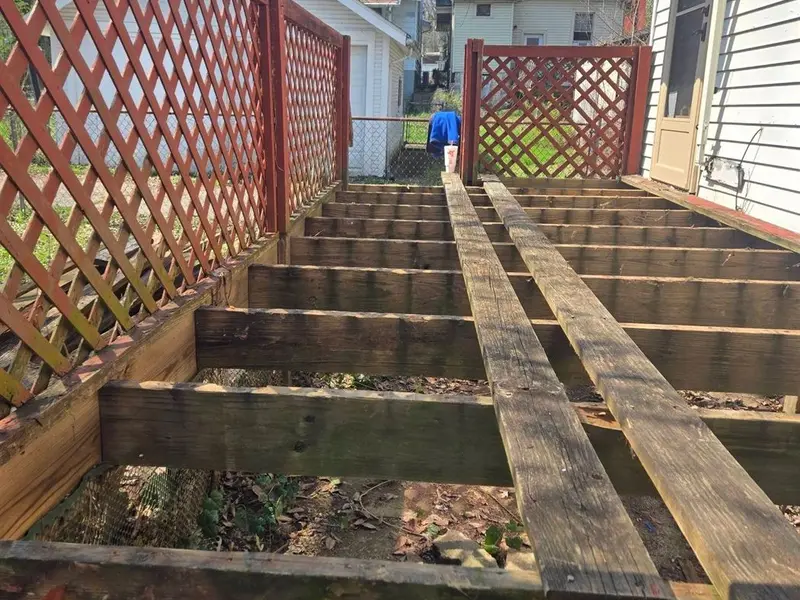
The Deck Repair Wizard repairs, restores and refinishes decks across Ellicott City, Maryland — tall multi-level decks standing over walkout basements on the hillsides, shaded surfaces going green under the valley canopy, and 30-year-old framing quietly giving out where nobody looks. We're a repair company, not a deck builder: if your deck can be saved we save it, and if it can't we say so plainly instead of handing you a replacement quote.
Ellicott City's decks are hitting their first real repair cycle
About 50.6% of Ellicott City's housing is detached single-family and the median home here was built in 1989 — two numbers that explain most of what we see. A house finished around 1989 usually got its deck within a few years, which puts a large share of Ellicott City decks at 25 to 35 years old: the age where finish, fasteners and framing all reach the end of their lives at once.
That timing matters because of what these decks are built from. Pressure-treated southern yellow pine is the default, and the Southern Pine Council's industry range is 10 to 15 years of service life with maintenance — under 10 if the wood was never sealed. With median home values between $658,300 and $686,219 and household income around $148,389 across the Ellicott City CDP ($190,061 in the 21042 ZIP), these are houses where the deck is worth repairing properly rather than patching.
The good news is that at this age the framing is often still sound while everything attached to it is worn out — the profile where deck board replacement and refinishing cost a fraction of a rebuild. The bad news is the ledger. The board bolting your deck to the house is the most failure-prone component on any deck, and late-1980s and 1990s decks were routinely nailed rather than bolted, with no continuous flashing behind them. Here's how that failure develops and how to check yours.
The seven hills are why Ellicott City decks are structural work
Ellicott City was built on seven hills in the Tiber and Patapsco river valleys, and the terrain changes the job. On a flat lot a deck sits two or three feet off the ground and a soft post is an inconvenience. On these slopes, decks routinely stand a full story or more above grade on 6x6 posts over a walkout basement — and every failure mode gets more serious with height:
- Guards carry more consequence. The code requires a guard wherever the walking surface is more than 30 inches above grade, at least 36 inches high on a one- or two-family home, with no opening a 4-inch sphere can pass through.
- Lateral load becomes real. The code calls for hold-downs resisting 1,500 pounds of tension at each end of the ledger — two rated at 1,500 pounds within 24 inches of each end, or four rated at 750 pounds — in addition to the ledger bolts, not instead of them.
- Stairs get long. Hillside stair runs load stringers and handrails hard, and stringers here often rest on soil or a dropped block instead of a frost-depth footing — bottom-up rot with no warning until a tread gives.
- Post bases stay wet. The code requires a one-inch standoff above concrete for weather- and splash-exposed post bases, and wood within six inches of exposed ground must be ground-contact rated. On a sloped lot, splash-back is constant.
Downtown Ellicott City along MD-144 (Main Street) has a documented severe flood history, and structures in the low ground near the Tiber have seen water events a hillside deck never does. If yours has been submerged or had debris driven against it, the conversation starts at the framing and footings, not the surface.
What the weather does to a deck in the valley
Ellicott City gets roughly 45 inches of rain a year — the sum of the National Weather Service's 1991–2020 monthly normals at BWI — plus about 19.3 inches of snow, and temperatures that swing above and below freezing repeatedly through the winter. Water works into every joint, freezes and pries it wider each season. Humidity sits near 75% from August through October and the freeze-free season runs over 230 days, so rot and mildew get a long working window.
Then there's the canopy. The valley slopes hold heavy tree cover, and leaf and pine-needle debris blocks sunlight and compounds algae and mildew growth. Horizontal boards hold standing water while vertical faces shed it, which is why the walking surface fails first — and why the shaded half of an Ellicott City deck can look a decade older than the sunny half. Water-repellent sealers generally need reapplication every 12 to 18 months, and solid-color finishes last one to three years on horizontals versus three to seven on vertical faces.
Deck repair services we do in Ellicott City
- Structural and rot repair — rotted joists, failing ledgers, sinking posts and sagging framing on tall hillside decks.
- Railing repair and code retrofit — the highest-value fix on a deck standing a story above the yard.
- Stair and step repair — stringers, treads, handrails and stair footings on long hillside runs.
- Deck board replacement — soft, cupped and splintering boards swapped and blended so it doesn't look patched.
- Deck restoration, power washing and staining and sealing for the shade-and-algae side of the problem.
- Deck safety inspections — a documented check of ledger, framing, posts, footings, railings and stairs, with photos and a written punch list.
Howard County deck permit rules — stricter than people expect
Howard County does not give you the 30-inch height exemption most homeowners assume exists. Here is what actually applies in Ellicott City:
- Only decks under 25 square feet are exempt. There is no height-based exemption — a deck six inches off the ground still needs a permit if it exceeds 25 square feet.
- Board-only replacement is exempt as ordinary repair. Replacing worn decking on sound framing needs no permit — Howard is one of only two counties in this metro that say so explicitly.
- Howard is ahead of its neighbors on code, having moved to the 2024 International Residential Code effective September 7, 2025, while Baltimore, Anne Arundel, Harford and Carroll counties remain on the 2021 family.
- Inspections run footing, framing, then final, and footings are dug to a 30-inch frost depth.
- Staining, sealing and power washing are not addressed in the county's permit materials at all — which is not the same thing as "no permit needed," and we'd rather say it accurately.
We tell you which side of that line your job falls on before work starts. For the full picture, including how village architectural review works down the road in Columbia, read our Howard County deck permit and Columbia approval guide.
Where we work in Ellicott City
We cover 21042, 21043 and 21041, working off US-29, US-40, I-70, MD-100, MD-103, MD-99 and MD-144:
- Dunloggin, Mount Hebron and Normandy — established streets where the deck is original to the house.
- Centennial and Dorsey's Search — near Centennial Park, with the mature tree cover behind most of our restoration work.
- Turf Valley — around country club grounds dating to 1958; larger decks, more linear feet of guard to keep solid.
- Worthington and Jonestown — hillside lots where walkout-basement decks are the norm.
- Ilchester and Oella — in the Patapsco valley, where shade, humidity and steep grade stack up on one structure.
- Historic downtown near Ellicott City Station, the oldest surviving train station in the country, built in 1830.
If you're on the Howard County line, we also work next door in Columbia — where every property sits under village architectural covenants — and across the Patapsco in Catonsville, where Baltimore County's much stricter 16-inch permit trigger applies instead. Wondering whether yours is a repair at all? Start with how we make the repair-or-replace call.