Deck power washing removes algae, mildew, embedded dirt and failed finish from the surface of a deck — and on its own, it accomplishes almost nothing lasting. Washing leaves clean, bare, open wood, which is precisely the condition in which sunlight and rain do the most damage. That is why we sell washing and finishing as one project: wash, dry, then seal or stain. If all you want is a clean deck for a party next weekend, say so and we will do exactly that. If you want the deck to still look good next summer, the finish is the part that gets you there.
This is also the honest answer to the most common quote we get asked to beat. A cheap standalone wash is cheap because it is half a job. Nationally, Fixr puts a standalone deck power wash at $150 to $500, while the same source puts washing as restoration prep at $0.30 to $0.40 per square foot — the wash is the small number in a refinishing project for a reason.
When does a deck need washing?
Short answer: when growth, dirt or a failing finish is between you and the wood. Look for:
- Green film in shaded or north-facing sections — algae, which thrives where the boards stay damp
- Black or dark grey streaking — mildew, a surface fungus that also feeds on the oils in some finishes
- A slick surface after rain — that slipperiness is biological growth, not the wood itself
- Leaf and needle stains where debris sat over winter; debris blocks sunlight and compounds algae and mildew growth
- Finish flaking or peeling in sheets — that has to come off before anything new goes on
- Water soaking straight in rather than beading — the existing finish has stopped protecting the wood
Two conditions washing will not solve
Grey, UV-degraded surface wood needs sanding, not just washing — that is a full deck restoration. And soft, spongy wood is rot: pressure will blow it out rather than clean it. If a screwdriver sinks into a post base, a stair stringer or a joist, that is structural and rot repair territory and it comes before any finish work.
How much pressure is too much on a deck?
Enough pressure to strip a deck is more than enough pressure to destroy it, and the damage is permanent. Wood is not uniform: the soft spring growth between the harder grain lines erodes first. Held too close, held in one spot, or driven across the grain instead of along it, a pressure washer tip carves that soft wood away and leaves a furred, wavy, fuzzy surface. That surface cannot be washed smooth again. It has to be sanded — sometimes heavily — and until it is, it absorbs stain unevenly and looks blotchy no matter how good the product is.
The variables that actually matter:
| Variable | What causes damage | What we do instead |
|---|---|---|
| Tip angle | Narrow, concentrated tips (the red one) | Wide fan tips that spread the force |
| Distance | Tip close to the board face | Held well back, adjusted for the species |
| Dwell time | Pausing in one spot mid-stroke | Continuous motion, no stopping on the wood |
| Direction | Sweeping across the grain | Working with the board, edge to edge |
| Chemistry | Using pressure to do the cleaner's job | Deck cleaner lifts the growth; water rinses it |
| Species | Treating soft pine like dense hardwood | Gentler on pine and cedar; adjusted for Ipe and mahogany |
What's included in a wash-and-stain package?
- Free inspection first — we look at framing, ledger, railings and stairs before we wet anything
- Furniture, planters and grills moved; plants and shrubs protected and rinsed
- Debris cleared from between the boards, where most of the damp lives
- Deck cleaner applied and given time to work on algae, mildew and dirt
- Stripping where an old film finish has to come off completely
- Controlled-pressure rinse, worked with the grain
- Wood brightener and neutralizer after any stripper or strong cleaner
- A planned dry window — two to three dry days minimum before finishing
- Light sanding where the wash has raised the grain
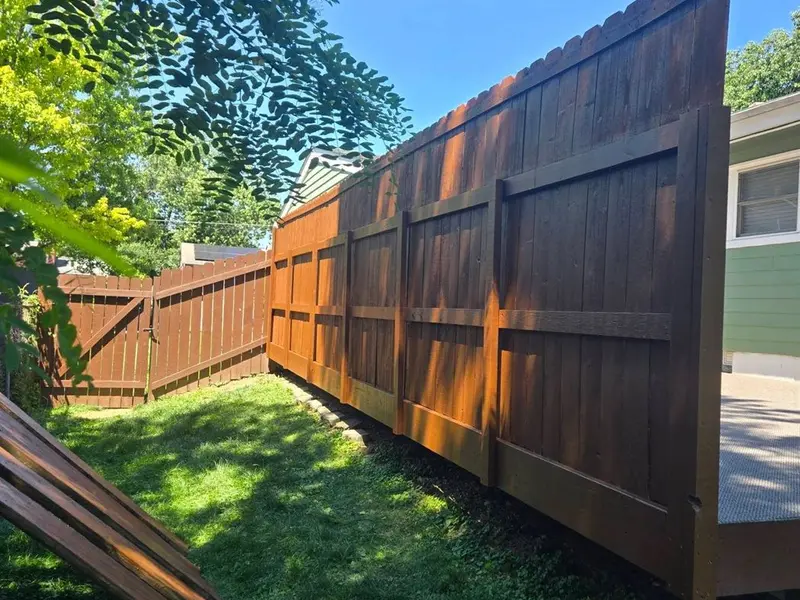
- Sealer or stain on boards, railings, caps, stairs, skirting and privacy walls
- Cleanup, walkthrough and a workmanship warranty
What does the process look like, day by day?
- Day 1 — inspect and prep. We check the deck's condition, clear it, protect the plants and note anything that needs repair before finishing.
- Day 1 — clean or strip. Cleaner or stripper goes on, gets its dwell time, then comes off with controlled pressure. Brightener follows where it is needed.
- Days 2–3 — dry down. This is not idle time; it is the step that decides whether the finish lasts. Washing pushes water into the wood and it has to come back out.
- Day 3 or 4 — repairs and sanding. Bad boards replaced, popped fasteners pulled and re-driven, raised grain sanded flat.
- Day 4 or 5 — finish. Stain or sealer applied in dry conditions, with end grain and cut edges sealed because water gets in there first.
In Maryland the calendar does not always cooperate. Roughly 45 inches of rain a year (the sum of NWS BWI 1991–2020 monthly normals) and 30 thunderstorm days a year in eastern Maryland, peaking in July, means we work the forecast. Here is how we pick the best time of year to stain a deck in Maryland.
Which finish goes on after the wash?
Answer first: the more pigment a finish carries, the longer it lasts and the less grain shows. And the walking surface always comes due first — horizontal boards hold standing water while vertical faces shed it.
| Finish | Horizontal service life | Vertical service life |
|---|---|---|
| Water-repellent sealer | 12–18 months, sometimes 6–12 in sun and heavy traffic | Somewhat longer |
| Transparent / semi-transparent stain | 12–18 months | Longer than horizontal |
| Solid-colour stain | 1–3 years | 3–7 years |
Full detail on choosing between them lives on the deck staining and sealing page, and how often to stain a deck in Maryland covers the maintenance interval.
What does deck power washing and staining cost?
Every figure below is a national average — no Maryland-specific published cost data for deck work exists. Baltimore-area pricing varies with deck size, height, access and how much of the old finish has to be stripped rather than washed.
| Line item | National range | Source |
|---|---|---|
| Deck power washing (standalone) | $150–$500 | Fixr |
| Deck power washing (standalone, alternate) | $200–$400 | Bob Vila |
| Washing as prep | $0.30–$0.40 per sq ft | Fixr |
| Washing as prep (alternate) | $0.50–$1.50 per sq ft | Bob Vila |
| Cleaning | $0.25–$0.50 per sq ft | Fixr |
| Stripping an old finish | $1–$3 per sq ft | Fixr |
| Sanding | $1–$4 per sq ft | Fixr |
| Mold / mildew treatment | $0.25–$1.50 per sq ft | Bob Vila |
| Staining (project) | $550–$850, average near $750 | Fixr |
| Staining (project, alternate) | $540–$1,250 typical, average $775 | Bob Vila |
| Seal and stain together | $800–$1,700 | Bob Vila |
Fixr also publishes staining costs by deck size nationally: about $160–$400 for 80 square feet, $290–$720 for 144, $560–$1,400 for 280 and $800–$2,000 for 400. Our Baltimore deck repair cost guide sets these alongside every other repair line item.
Why hire a local pro to wash and stain a deck?
- Pressure damage is permanent. The single most common way a homeowner ruins a deck is a rental washer with the wrong tip — and the repair is sanding, not washing.
- Drying is a weather judgment. Humidity near 75% from August through October means a deck that feels dry on top often is not. Finish applied on damp wood fails in a season.
- Washing reveals problems. Clean wood shows rot, splits and corroded fasteners that dirt was hiding. We are repair specialists, so we can fix what turns up instead of handing it back to you.
- We come back. Based in Lutherville-Timonium at I-695 and I-83, we can reschedule a finish day around a storm without abandoning the job.
- Insured and bonded, with a workmanship warranty and free written estimates.
Where we wash and stain decks
Across the Baltimore metro, including Lutherville-Timonium, Towson, Catonsville, Perry Hall, Kingsville, Columbia, Crofton and Arnold. Tree cover changes the job: Lutherville-Timonium and Catonsville sit under mature Piedmont canopy, and Arnold's Broadneck Peninsula location — 20.18% water with heavy canopy — keeps decks damp longer, which means more algae and a longer dry-down before finishing.
Deck Washing & Staining FAQs
Can I power wash a deck myself?
You can, and this is where most homeowner deck damage comes from. A consumer pressure washer easily produces more pressure than softwood can take, and pressure-treated southern yellow pine is soft. Held too close, held in one spot, or swung across the grain, the tip erodes the soft spring wood between the harder grain lines and leaves a permanently furred, wavy surface. That damage does not wash out, does not sand out easily, and drinks stain unevenly forever after. If you do it yourself, use the widest fan tip you have, keep it moving with the boards, stay well back from the surface, let a deck cleaner do the actual work, and never wash within a foot of a light fixture or a siding joint.
How much pressure should be used on a wood deck?
Less than you think, and the number matters less than the technique. The variables that decide whether wood gets damaged are tip angle, distance from the surface, dwell time in one spot and direction of travel — a wide fan tip kept moving with the grain at a sensible distance will clean without eroding. Softwoods like pressure-treated southern yellow pine and western red cedar need the gentlest approach; dense hardwoods like Ipe and mahogany tolerate more but scar visibly when they are marked. We treat the chemistry as the cleaner and the water as the rinse, which is the opposite of how most homeowners approach it.
What is the difference between algae and mildew on a deck?
Green film is algae and it grows where the deck stays wet and shaded — under trees, on the north side of the house, along a wall that blocks afternoon sun. Black or dark grey streaking is mildew, a surface fungus that also feeds on the wet and on the oils in some finishes. Both are slip hazards, both come off with the right cleaner, and neither is removed by pressure alone. In this climate they are near-universal: humidity sits near 75 percent from August through October, and leaf and pine-needle debris blocks sunlight and compounds the growth.
How long does a deck need to dry before staining?
Plan on at least two to three dry days after washing before any finish goes on, and often longer here. Washing drives water into the wood, and finish applied over wood that has not dried down will not bond — it fails within a season, whatever the can promises. Maryland humidity around 75 percent from August through October stretches drying time, and roughly 45 inches of rain a year means the forecast usually decides the finish day. We schedule washing and staining as one project with the dry window planned in, rather than treating the stain as a separate booking months later.
Why sell washing and staining as one package?
Because a washed deck left bare is a deck with no protection at all. Washing strips off the growth, the dirt and whatever finish was left, and leaves clean, open wood — which is exactly the condition in which UV degrades the surface fastest and rain soaks straight in. Wood is rapidly degraded by short-wavelength UV according to USDA Forest Products Laboratory research, so a bare deck starts greying again within weeks. The wash is prep. The finish is the product. Buying only the wash means paying for the prep twice.
How much does deck power washing and staining cost?
No Maryland-specific published pricing exists for deck work, so these are national averages. Nationally, Fixr puts deck power washing at $150 to $500 and Bob Vila at $200 to $400; as restoration prep it runs $0.30 to $0.40 per square foot per Fixr or $0.50 to $1.50 per square foot per Bob Vila. Staining runs $550 to $850 with an average near $750 per Fixr, and Bob Vila reports a typical $540 to $1,250. Seal and stain together runs $800 to $1,700 nationally. Baltimore-area pricing depends on deck size, height, access and how much stripping the old finish needs.
Do I need a permit to power wash or stain a deck in Maryland?
Staining, sealing and power washing are not addressed in any local county's permit materials. That is the accurate statement: those documents simply do not cover refinishing work. Permits become a question when washing uncovers repairs — rotted boards, a bad railing, framing damage — and that answer changes by county. Baltimore County requires a permit for decks over 16 inches above grade or larger than 120 square feet, while Howard and Anne Arundel counties treat board-only replacement as ordinary repair. We tell you which applies before any repair work begins.
Related services
- Deck staining and sealing — the finish half of this package in full detail
- Deck restoration — when the wood needs sanding and repairs, not just cleaning
- Deck board replacement — for the boards a wash exposes as too far gone
- Composite and Trex repair — composite decks need cleaning too, but not the same way
- What deck repairs cost in the Baltimore area