Composite repair kits — filler, epoxy, putty, colour-matched sticks — fix cosmetic dings in low-traffic corners and very little else. If the patch you applied is lifting, showing, or the spot came back, the kit was never the right tool. Composite boards expand and contract with temperature while cured filler does not, so a patch works loose at its edges; the colour is an approximation on day one and drifts further as the surrounding board keeps weathering; and a filler does nothing about the reason the board failed, which is usually trapped moisture or wood framing moving underneath. The fix that lasts is board replacement, done one board at a time without tearing out the deck.
That is the business we are in. Every deck company in this market sells new decks — and a composite deck with three bad boards is an easy rebuild pitch, because the boards are the expensive part. We would rather replace three boards.
When won't a repair kit cut it?
- The damage is in a traffic path. Feet, furniture and grills find a filled spot and work it loose.
- The board has cracked through or split at a fastener. That is a structural failure of the board; filler is cosmetic.
- The spot came back after cleaning. If mold or spotting returns, the board is still holding moisture — patching seals the symptom in.
- The board flexes or feels soft underfoot. That is almost never the board. That is a joist, and it needs structural and rot repair.
- You can see the patch. Composite colour is a manufactured blend; filler is a single tone. On a surface you look at every day, it shows.
- Several boards are involved. Once you are patching a fourth spot, replacement is cheaper and looks finished.
What goes wrong with composite decks?
Composite was sold as maintenance-free. It is lower-maintenance than wood, which is not the same thing — and the older generations especially have a track record.
| Problem | What's happening | What actually fixes it |
|---|---|---|
| Mold and mildew spotting | Wood flour in the composite plus moisture that never dries — shade, planters, debris in the board gaps | Proper cleaning, clearing the gaps, and replacing boards where the surface has broken down |
| Surface flaking | The outer surface of older uncapped board degrading | Board replacement; there is no coating that restores it |
| Fading | UV weathering, mostly uniform across a deck | Usually lived with; the issue is matching a new board into it |
| Scratches and gouges | Furniture, pets, grills, shovels | Blending on some uncapped boards; replacement on capped board, which cannot be sanded |
| Loose or popped fasteners | Thermal movement working clips and screws loose | Re-securing with the correct hidden-fastener hardware |
| Sagging or bouncy sections | Wood framing underneath failing, or joist spacing wrong for the board | Framing repair — the boards are fine |
| Stains from planters and grease | Standing moisture and oils on a porous older surface | Cleaning; replacement where it has set permanently |
The Trex history, stated accurately
Mahan v. Trex, filed in 2009, alleged that composite decking manufactured before 2009 was susceptible to mold, mildew, fungus, spotting and surface flaking. Trex denied the allegations and the case settled for $8.25 million, with product replacement plus partial labour reimbursement for class members. That is an allegation resolved by settlement — not a proven defect, and we will not characterise it as one. The useful takeaway for a homeowner: if your composite deck dates to the mid-2000s and it is spotting or flaking, that behaviour is documented and you are not imagining it. Trex itself is headquartered in Winchester, Virginia, about two hours from Baltimore, which makes it one of the more common composite brands on decks around this metro.
What's included in a composite deck repair?
- Free inspection of the boards, the fastening system and — importantly — the wood framing underneath
- Identification of the board type: capped or uncapped, and which fastening system it uses
- Honest sourcing assessment: whether matching material is still available, and how close the match will be
- Single-board or section replacement without disturbing the rest of the deck
- Hidden-fastener clips released and correctly reset on both neighbouring boards
- Loose and popped fasteners re-secured with the right hardware
- Deep cleaning of mold, mildew and staining, and clearing the board gaps where debris holds damp
- Framing, ledger, post and railing check while the boards are up — the part nobody else looks at
- Railing, stair and fascia repairs on composite systems
- Cleanup, walkthrough and a workmanship warranty
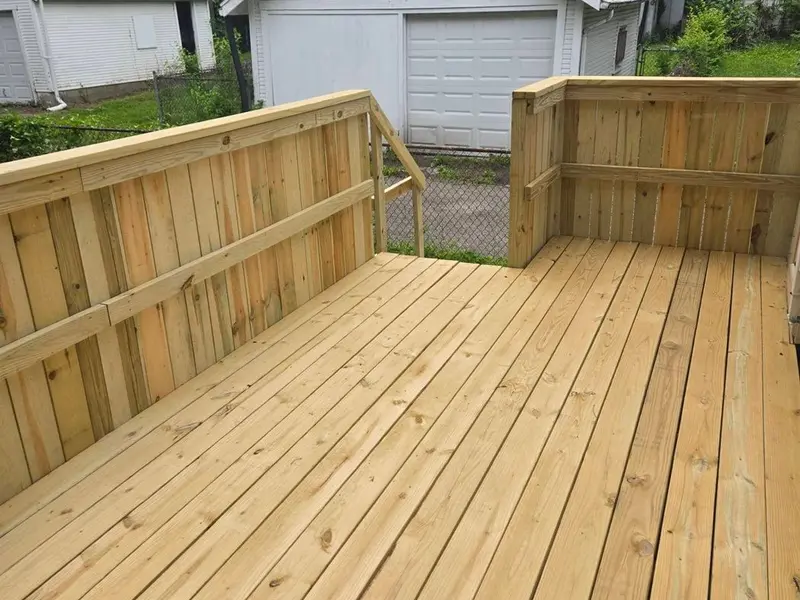
How do you replace one composite board?
- Identify the system. Face-screwed, grooved-edge with hidden clips, or a proprietary track. This determines everything about how the board comes out.
- Source the match. We check brand, profile and colour, and tell you honestly how close we can get. A board made today will not match one that has weathered fifteen years in the sun.
- Release the fasteners. With hidden clips, the neighbouring boards have to be freed on both sides of the one coming out.
- Remove the board and inspect the joists. This is the only time you get to see the framing under that section. We look at joist condition, fastener corrosion and blocking while it is open.
- Repair the framing if it needs it. A new board over a failing joist is a waste of a new board.
- Set the new board with correct gapping for thermal movement — composite moves more than wood, and boards set tight buckle.
- Re-secure the neighbours with new clips where the old ones are fatigued, and check the run for level and alignment.
- Placement strategy where the colour won't match. Sometimes the better answer is moving a weathered board from an out-of-sight area — under a bench, at the house wall — into the visible spot and putting the new board where nobody looks.
Don't forget what's holding it up
The single biggest blind spot on composite decks: the boards are composite, but the joists, beams, posts and ledger are almost always pressure-treated wood, and they age like any other deck frame. A flawless composite surface can sit on twenty-year-old framing with a nailed ledger and no flashing behind it.
The ledger board is the most failure-prone component on any deck, and decks built in the 1980s and 1990s were routinely attached with nails rather than bolts. The code requires continuous flashing at the ledger-to-house connection and hold-downs resisting 1,500 pounds of tension at each ledger end. NADRA estimates roughly 30 million of the 60-plus million decks in the United States are past their recommended service life and that fewer than half were built to code — and a composite surface does not exempt a deck from that list. Here is the full deck safety checklist we work from, and if you would rather have it documented, we offer a deck safety inspection with photos and a written punch list.
How should a composite deck be cleaned?
Gently, and with the gaps cleared. Composite does not need stain or sealer — and should not be given any — but it does need washing, especially here. Humidity near 75% from August through October keeps shaded sections damp for weeks, and leaf and pine-needle debris blocks sunlight and compounds algae and mildew growth. Debris packed into the board gaps is the single most common cause of mold spotting we find.
- Clear the gaps between boards every autumn — that is where the damp lives
- Keep planters on feet so water is not trapped against the surface
- Wash with a composite-appropriate cleaner rather than relying on pressure
- Keep pressure low; excessive pressure can damage a composite surface as surely as it furs wood — see our deck power washing page for how we handle pressure
- Never apply deck stain or sealer to composite; if you want colour, that is a wood deck staining conversation, not a composite one
What does composite deck repair cost?
All figures below are national averages. No Maryland-specific published deck cost data exists, so use them to sanity-check a quote, not as a Baltimore price. Local pricing varies with board count, fastening system, material availability and framing condition.
| Line item | National range | Source |
|---|---|---|
| Composite deck repair | $12–$45 per sq ft | Fixr / Bob Vila |
| Board replacement | $15–$55 per sq ft | Fixr |
| Board replacement project | $500–$4,000 | Bob Vila |
| Overall deck repair | $500–$3,000, average near $1,500 | Fixr |
| Popped screws / missing fasteners | $100–$200 | Bob Vila |
| Mold treatment | $200–$600 | Bob Vila |
| Cracks | $150–$500 | Bob Vila |
| Creaky or loose boards | $150–$600 | Bob Vila |
| Joist repair / replacement underneath | $100–$300 / $150–$350 each | Fixr / Bob Vila |
| Composite railing material | $80–$165 per linear foot | Fixr |
The comparison worth making: a composite board replacement project at the national $500–$4,000 range against a full composite rebuild, where composite material alone runs $12–$45 per square foot before labour. That gap is why we push back on rebuild quotes. Our Baltimore deck repair cost guide lays out every line item, and our repair-or-replace guide walks through where the line actually falls.
Why hire a local pro for composite repair?
- Board identification. Capped versus uncapped changes what can be sanded, blended or only replaced. Guessing wrong ruins a board.
- Hidden fasteners. Pulling a clipped board without damaging its neighbours takes doing it before.
- Sourcing and honesty about matching. Older lines get discontinued. We would rather tell you the match will be visible and discuss placement than hand you a surprise.
- Thermal gapping. Composite moves more than wood. A board set tight in October buckles in July, when average highs run near 88.8°F.
- We look underneath. Most composite calls are board calls; a fair number turn out to be framing. We are equipped for both.
- Insured and bonded, free written estimates, workmanship warranty.
Where we repair composite decks
Across the Baltimore metro from Lutherville-Timonium, including Ellicott City, Columbia, Perry Hall, Severna Park, Crofton and Eldersburg. Composite clusters where the housing is newer: Perry Hall's median build year is 1986 and the community grew from 5,446 people in 1970 to 29,409 in 2020, while Ellicott City's median is 1989 — which puts a lot of first-generation composite decking, installed during the 2000s renovation and addition wave, right in the age band where spotting and flaking show up.
One Columbia note worth knowing: every property there sits under recorded covenants administered by the village architectural committee, and deck work requires an application before construction. In Hickory Ridge, the process runs Exterior Alteration Application to Covenant Advisor to a Resident Architectural Committee property visit, with a decision by email typically in two to four weeks. Where multiple covenants apply, the most restrictive governs. Our Howard County and Columbia approval guide covers it in full.
Composite & Trex Repair FAQs
Do composite deck repair kits actually work?
For small cosmetic dings in a low-traffic spot, sometimes. For anything structural or anything you will look at every day, rarely. Filler, epoxy and putty kits fail on composite for three reasons: composite flexes and expands with temperature while cured filler does not, so the patch works loose at the edges; the colour is a compromise from day one and diverges further as the board around it weathers; and a kit does nothing about why the board failed, which on composite is often water sitting in a spot that never dries or wood framing giving way underneath. If you have already tried a kit and the patch is lifting or showing, replacing the board is usually cheaper than trying again.
Can you replace a single composite board without rebuilding the deck?
Yes, and that is most of what this service is. A composite board in the middle of a run can be removed and replaced without disturbing the boards around it. The complications are the fastening system and the colour. Many composite decks use hidden fasteners set in a groove along the board edge, so getting one board out means releasing the clips on both sides and re-securing the neighbours afterward. Colour is the other issue: a board made today will not match a board that has been weathering in the sun for fifteen years, so we discuss placement, sourcing and blending options before we start.
Why does my composite deck have mold spots?
Because older composite is not the maintenance-free product it was sold as, and because this climate is hard on any surface that stays damp. Wood-plastic composite contains wood flour, and where a board holds moisture — shaded areas, spots under planters, places where debris collects between boards — mold and mildew can take hold on and in the surface. Maryland humidity sits near 75 percent from August through October, which keeps those areas damp for weeks at a time. Clearing debris from the board gaps and keeping planters up off the surface prevents more of it than any product does.
Wasn't there a lawsuit about Trex decking?
Yes. Mahan v. Trex, filed in 2009, alleged that composite decking manufactured before 2009 was susceptible to mold, mildew, fungus, spotting and surface flaking. Trex denied the allegations and settled the case for $8.25 million, with product replacement plus partial labour reimbursement for class members. It is important to state this accurately: it was an allegation resolved by a settlement in which the company denied the claims, not a proven defect. The practical takeaway for homeowners is simply that a composite deck installed in the mid-2000s is not maintenance-free, and if yours is spotting or flaking you are not imagining it. Trex is headquartered in Winchester, Virginia, roughly a two-hour drive from Baltimore.
Can faded or scratched composite be restored?
Partly, and it depends on the generation of the product. Early uncapped composite boards fade as the surface weathers, and that fading is generally uniform enough to live with; the problem is when a new board is dropped into the middle of it. Scratches are different depending on construction: on some uncapped boards a light scratch can be blended, while a capped composite has a factory shell that cannot be sanded back without exposing the core underneath. We will tell you honestly which one you have and whether blending, board rotation or replacement is the better answer. What we will not do is sand a capped board and hope.
What does composite deck repair cost?
No Maryland-specific published cost data exists for deck work, so these are national averages. Nationally, composite deck repair runs $12 to $45 per square foot, board replacement runs $15 to $55 per square foot, and a board replacement project runs $500 to $4,000 per Bob Vila. Overall deck repair nationally sits at $500 to $3,000 with an average near $1,500 per Fixr. Popped screws run $100 to $200 and mold treatment $200 to $600. Baltimore-area pricing depends on how many boards are involved, the fastening system, whether matching material can be sourced, and the condition of the wood framing underneath.
Is the framing under a composite deck still wood?
Almost always, and this is the thing composite owners overlook. The boards are composite but the joists, beams, posts and ledger underneath are usually pressure-treated lumber, and they age exactly like any other deck frame. A composite surface can look flawless over framing that is twenty years old with a nailed ledger and no flashing — and the ledger connection is the most failure-prone part of any deck. When we are on a composite deck for a board repair, we check the frame underneath as a matter of course, because the surface tells you nothing about what is holding it up.
Related services
- Deck board replacement — the wood-deck version of the same work
- Structural and rot repair — for the wood frame under a composite surface
- Deck safety inspection — documented check of ledger, framing, footings, railings and stairs
- Railing repair and code retrofit — including composite railing systems
- What deck repairs cost in the Baltimore area