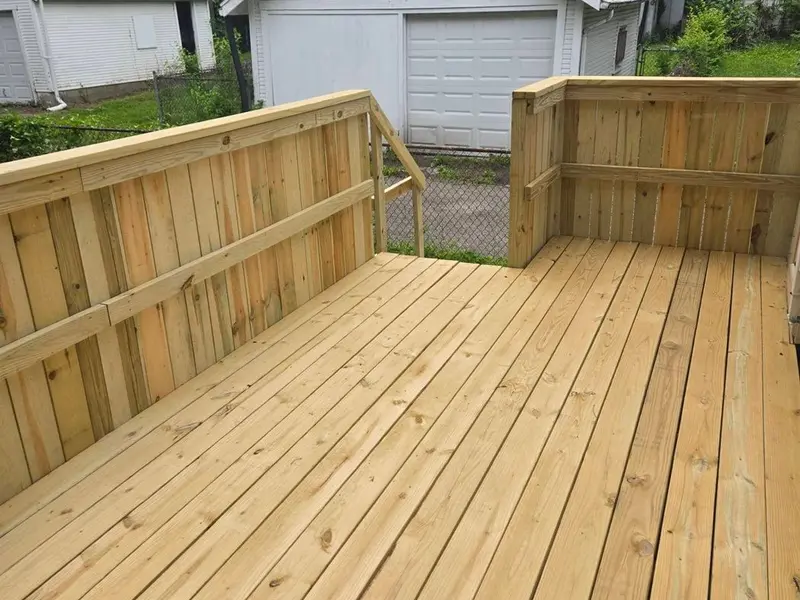
The Deck Repair Wizard repairs, restores, stains and waterproofs decks in Lutherville-Timonium, Maryland — and this is the town the whole service area radiates from. Our base sits at ZIP 21093, where I-695 meets I-83, which means a Lutherville or Timonium deck is usually the shortest drive on the schedule. It also means we've seen what happens to the particular kind of deck this town is full of: a wood deck added to a mid-century house sometime in the last forty years, and now asking for attention.
Lutherville-Timonium has almost exactly the deck stock we specialize in
Some towns are full of townhomes and patios. This one isn't. 84.2% of Lutherville homes and 70.7% of Timonium homes are single-family detached — houses with back yards, back doors and, overwhelmingly, back decks. That's the highest concentration of deck-bearing housing anywhere in our immediate service radius.
The second number is the one that decides what we find when we get there. The median build year is 1958 in Lutherville and 1964 in Timonium. Very few of those houses were built with a deck. The deck came later — added during the 1980s, 1990s and 2000s, when pressure-treated southern yellow pine was cheap and deck-building was the default backyard upgrade. That puts the typical Lutherville-Timonium deck at roughly 20 to 40 years old today.
Twenty to forty years is a specific and predictable stage in a deck's life. The boards are usually still there. The framing is usually still standing. But the connections — the ledger bolted (or, in the bad cases, nailed) to the house, the post bases, the stair stringers, the railing posts — are at exactly the age where they start letting go. Pressure-treated pine is generally credited with a 10 to 15 year service life with maintenance, and up to 15 to 25 years above ground when every field cut is resealed. Decks that were never sealed fall well short of that. Most of the decks we look at here are past that window and running on borrowed time in the hardware, not the lumber.
That's also why we're repair specialists rather than builders. A 1990s deck in Timonium usually does not need to be torn down. It needs the ledger detail corrected, a handful of joists sistered or replaced, the post bases lifted off the dirt, the railing brought up to current guard requirements, and a proper finish put back on. This is what a failing 1980s ledger board actually looks like — worth reading before you call anyone, including us.
What the terrain and the weather do to a deck in 21093
Lutherville-Timonium sits on rolling Piedmont ground, with the wooded Loch Raven Reservoir watershed off to the east and heavy mature canopy through the older streets. Two things follow from that.
Sloped lots make tall decks. Rolling ground means a lot of local decks step down off the back of the house well above grade, carried on 4x4 or 6x6 posts with stairs running down to the yard. Height changes everything about a repair: it puts the deck firmly over Baltimore County's permit trigger, it makes the guard and stair requirements non-negotiable, and it means a post-base or footing problem is a safety issue rather than a cosmetic one.
Canopy keeps decks wet. Shade and leaf litter are the enemy of a deck surface. Debris blocks the sunlight that would dry the boards, and horizontal decking holds standing water that vertical railings and skirting simply shed. That's why the walking surface always fails before anything else you can see.
The regional climate numbers back it up. The Baltimore area takes roughly 45 inches of rain a year (the sum of the National Weather Service's 1991–2020 monthly normals at BWI) plus about 19.3 inches of snow, and the temperature swings above and below freezing repeatedly through the winter — water gets into a joint, freezes, expands, and pries that joint a little wider every time. Humidity runs near 75% from August through October, which is prime algae and mildew season on a shaded deck, and the freeze-free season runs past 230 days, giving rot a long working year.
The repairs we're called for most in Lutherville and Timonium
- Structural and rot repair — rotted joists, a soft rim or ledger, sinking posts and sagging framing. The repairs that decide whether a deck is safe to stand on.
- Deck board replacement — cupped, cracked and soft boards pulled and blended into the existing surface so the deck doesn't look patched.
- Railing repair and code retrofit — guards that move when you lean on them, rebuilt to current height and spacing requirements.
- Stair and step repair — stringers resting on soil or a loose block instead of a proper frost-depth footing is one of the most common findings on a deck of this vintage.
- Full deck restoration and staining and sealing — strip, sand, repair and refinish for a deck that's structurally fine but looks finished.
- Deck safety inspections — a documented check of the ledger, framing, posts, footings, railings and stairs with photos and a written punch list, which is what most people actually want before they decide anything.
If your deck is composite rather than wood, that's a different conversation — see composite and Trex repair. And if the surface simply won't shed water any more, waterproofing and flashing repair is usually where we start.
The honest version: we'll tell you when a deck is past saving. Repair is cheaper than replacement whenever the framing is sound — but when rot is through the beams and posts, or the structure can't be brought up to current code, we say that out loud instead of selling you a repair that buys one season. Here's how we make the repair-or-replace call.
Baltimore County permit rules that apply to your Lutherville-Timonium deck
Lutherville-Timonium is unincorporated Baltimore County, so the county's rules govern — and they are stricter than most homeowners expect.
- A permit is required for any deck more than 16 inches above grade, or larger than 120 square feet. Most people have heard the national 30-inch figure. In Baltimore County that figure is simply wrong, and 16 inches is barely two steps down off a back door.
- There is no exemption in a Historic District, on the Landmarks List, in a floodplain, or in the Critical Area. That matters directly here: the Lutherville Historic District is on the National Register, and a deck there goes through permitting whatever its size.
- Inspections run footing, framing and completion. The framing inspection happens before the decking goes down, which is why a rebuild done in the wrong order gets expensive.
- Baltimore County adopted the 2021 IRC effective September 3, 2024.
- Board-only replacement is not addressed as an exemption in Baltimore County the way it is in Howard County. We never assume it's exempt.
- Staining, sealing and power washing are not addressed in any county's permit materials. We state that precisely rather than promising you no permit is needed.
Worth knowing on the technical side, because it's where old local decks fall short: county specifications call for footings at a 30-inch frost depth, a minimum 10-inch thickness and 3,000 psi concrete; footings within 3 feet of the house wall must bear at the same elevation as the house foundation; lumber is southern pine #2 or better, AWPA-treated and ground-contact rated anywhere it touches soil; decks are attached with bolts, not nails; hardware is triple-dip galvanized or stainless; and a 6x6 post tops out at 12 feet. County deck guides predate the current code adoption, so confirm current span tables with the county. Full Baltimore County deck permit guide →
Where we work in Lutherville and Timonium
We cover both halves of the community and the ZIPs around them — the older streets near the Lutherville Historic District, the 1970s development at Mays Chapel, and out toward Greenspring Valley and Worthington Valley. Day to day that means working off York Road (MD-45), Dulaney Valley Road (MD-146), Seminary Avenue (MD-131), Padonia Road and Timonium Road, with I-83 and I-695 doing the rest.
If you're giving directions, the landmarks we hear most are the Maryland State Fairgrounds, St. Paul's Lutheran Church (1898) and the Loch Raven Reservoir shoreline. Most of our calls come from families in the Dulaney High School and Ridgely Middle School attendance areas, and the streets feeding Hampton Elementary, Lutherville Laboratory Elementary and Timonium Elementary.
Neighboring areas we serve from the same base: deck repair in Towson, a few minutes south, and Cockeysville and Hunt Valley straight up York Road. Perry Hall and Catonsville are also inside Baltimore County and under the same permit rules.