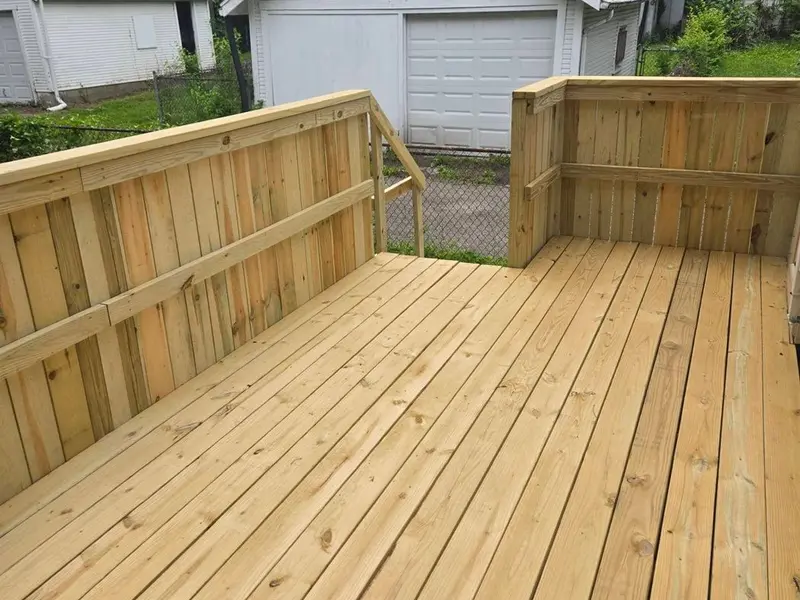
Crofton is the flattest market we serve, and that is genuinely good news for your wallet. Built from 1964 on the former Duvall farm, Crofton sits on level ground — which means fewer walkout basements, fewer multi-level decks standing a story above the yard, and far less of the height-driven structural work that dominates our hillside jobs. Most Crofton deck repair is surface, railing, stair and finish work. We would rather say that up front than talk you into something bigger.
What flat ground changes about a deck
Crofton runs a median household income around $154,592 and a median home value near $540,345, on former farmland with a 3.5-mile loop, Crofton Parkway, running through it. Decks here typically sit low and close to the yard. Three practical consequences follow:
- Less height-driven structure to fail. Guards are required over 30 inches above grade, at least 36 inches high on a house, with no gap a 4-inch sphere can pass through — but a lot of Crofton decks sit below or barely above that line, so guard and lateral-load work is a smaller share of the job than it is in the hillier parts of the metro.
- Shorter stairs, but the same failure point. Two or three risers instead of a full flight still means stringers and stair footings, and stringers resting directly on soil or a dropped block rot from the bottom up with no visible warning until a tread gives.
- Low decks trap moisture. A deck close to grade ventilates poorly underneath. The code requires a one-inch standoff above concrete for weather- and splash-exposed post bases, and wood within six inches of exposed ground must be ground-contact rated — details that get skipped often and matter most exactly where the deck sits low.
So the honest summary: in Crofton we do more deck board replacement, railing repair and refinishing than framing rebuilds. We still inspect the ledger, joists, posts and footings on every visit, because a low deck hides rot better than a tall one does.
Sun, rain and the finish cycle
Without the heavy canopy you get closer to the water, Crofton decks take more direct sun — and the USDA Forest Products Laboratory documents that wood is rapidly degraded by short-wavelength ultraviolet light, with further subsurface degradation from longer-wavelength violet and visible light. Sun, not shade, sets the refinishing clock here.
The rest of the weather still applies. The area gets roughly 45 inches of rain a year — the sum of the National Weather Service's 1991–2020 monthly normals at BWI — humidity near 75% from August through October, and temperatures that swing above and below freezing repeatedly through the winter, prying open every joint a little further each season. Horizontal boards hold standing water while vertical faces shed it, so the walking surface is always the first thing to go. As a baseline, water-repellent sealers generally need reapplication every 12 to 18 months, and solid-color finishes last one to three years on horizontals versus three to seven on vertical faces. Timing the work to Maryland's weather matters as much as the product you choose.
What we repair in Crofton
- Deck board replacement — cracked, cupped and splintering boards swapped and blended so the deck doesn't look patched.
- Railing repair and code retrofit — the most common safety fix on a low deck that still has a guard.
- Stair and step repair — short flights, but the same stringers, treads and footings.
- Deck restoration, power washing and stripping and staining and sealing — the bulk of Crofton work.
- Structural and rot repair where a low deck has been holding moisture against joists, posts or the ledger.
- Deck safety inspections with photos and a written punch list.
Approvals in Crofton: two different systems
Crofton's governance is split, and it catches homeowners out. The original 1964 planned community section is a Special Community Benefit District. The newer sections that filled in around it have individual homeowners associations. Those are different structures with different rules about exterior work, so there is no single Crofton answer about approval — check your own deed and association documents before scheduling. We will tell you what the county requires; what your association requires is set at that level.
Anne Arundel County permit rules
- An attached deck always requires a permit — regardless of size or height. Anne Arundel is the only county around Baltimore that draws this distinction, and on Crofton's low decks it is the rule that surprises people most.
- A detached deck is exempt only if it is under 200 square feet and under 3 feet high and outside the Critical Area — all three at once.
- Board-only replacement is exempt as ordinary repair, which covers a good share of Crofton work.
- Inspections run footing, framing and final, under the 2021 International Residential Code.
- Staining, sealing and power washing are not addressed in the county's permit materials at all — not the same thing as "no permit needed."
Where we work in Crofton
We cover 21114, working off MD-3 (Crain Highway), MD-424, MD-450 and the Crofton Parkway loop — Crofton Village and the newer subdivisions around it, the streets near Crofton Country Club, and the neighborhoods around Crofton Elementary, Crofton Meadows, Crofton Woods, Crofton Middle and Crofton High School, which opened in 2020. The area's history is close to the surface here: Linthicum Walks was listed on the National Register in 1984, the Katcef Archaeological Site in 1991, and White's Hall, the birthplace of Johns Hopkins, is nearby.
Elsewhere in Anne Arundel County we work up in Severna Park and Arnold, where waterfront humidity and heavy canopy create a very different set of problems on the same permit rules. North of here we cover Columbia in Howard County, where village covenants add an approval layer of their own. Not sure whether yours is a repair or a replacement? Here's how we make that call.