Deck staining and sealing protects wood from the two things that destroy it: water and sunlight. A sealer handles the water. Pigment handles the sun — which is why the more pigment a finish carries, the longer it lasts and the less wood grain you see. That single trade-off drives every decision on this page, and it is the thing most homeowners are never told before they pick a can. Get the finish type, the prep and the timing right and a deck holds for years; get any one of them wrong and it fails in a season regardless of what the label promised.
We are a repair company first, which changes how we approach finishing. We look at the deck before we look at the stain: a finish applied over soft boards, popped fasteners or a loose railing just seals in the problem and hides it from you for another year.
Sealer or stain — which does my deck need?
A sealer is a water repellent with little or no pigment. It slows water absorption and does almost nothing about UV. A stain carries pigment, and pigment is the UV block. The USDA Forest Products Laboratory documents that wood is rapidly degraded by short-wavelength UV, with further subsurface degradation from longer-wavelength violet and visible light — so a clear-sealed deck still goes grey, it just does not soak up rain while it happens. Many products do both jobs at once, so the real question is how much pigment you are willing to trade for grain.
| Finish type | What you see | Horizontal (floor, steps) | Vertical (rails, skirting) | Best for |
|---|---|---|---|---|
| Water-repellent sealer (clear) | Natural wood colour, no tint | 12–18 months, sometimes 6–12 in sun and traffic | Somewhat longer | New or very good wood you want left natural |
| Transparent stain | Full grain, light tone | 12–18 months | Longer than horizontal | Cedar and hardwoods worth showing off |
| Semi-transparent stain | Grain visible under real colour | 12–18 months | Longer than horizontal | The common choice on treated pine decks |
| Solid-colour stain | Texture only; colour reads like paint | 1–3 years | 3–7 years | Older, weathered or previously solid-stained decks |
The one-way door
Solid-colour stain is close to permanent as a decision. Once a film-forming solid is on a deck, going back to a semi-transparent look means stripping and sanding the whole surface — a full restoration, not a recoat. It is a good choice for a weathered deck. It is a poor first choice for a deck you would rather see the grain of.
Why does the deck floor always fail first?
Because horizontal boards hold standing water and vertical faces shed it. Rain sits on the walking surface, works into the grain and around the fastener heads, and stays. The same rain runs straight off a railing post. On top of that, foot traffic abrades the floor finish while nothing touches the railings, and leaf and pine-needle debris collects on the deck surface, blocking sunlight and compounding algae and mildew growth. That is the reason solid stain gives 1 to 3 years on a floor and 3 to 7 years on a railing — the same product, different jobs.
The practical takeaway: a maintenance plan that recoats the floor on a shorter cycle than the railings is cheaper and looks better than waiting for the whole deck to fail at once.
How do I know when it's time to re-stain?
Run the water-bead test every spring, before the season starts.
- Pick three spots: a main traffic path, a spot under a chair or table, and a section that gets full afternoon sun.
- Splash a cup of water on each.
- Watch for a minute or two.
- Beading = the finish is still working. Wait and check again next spring.
- Soaking in and darkening = the finish is done. The deck is absorbing rain, and every day it sits bare is a day of UV damage.
Other signs it is due: colour faded unevenly along the traffic lanes, grey showing through the tint, a chalky feel underfoot, and algae or mildew returning fast after a cleaning. Our guide to how often to stain a deck in Maryland covers the intervals in more depth.
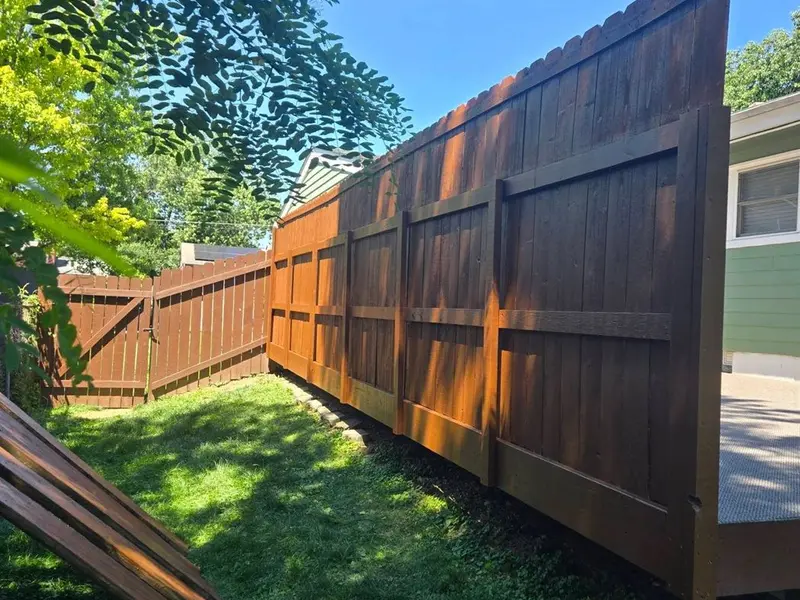
What's included when we stain a deck?
- Inspection of boards, fasteners, railings and stairs before anything is applied
- Furniture and planters moved; plants, siding and hardware protected
- Debris cleared from board gaps, where the damp lives
- Cleaning or controlled-pressure washing, with stripping where an old film finish must come off
- Brightener and neutralizer after any stripper
- A real dry-down window — usually two to three dry days minimum
- Sanding of raised grain, traffic paths and hand-contact areas
- Loose fasteners re-driven and failed boards flagged before finishing
- Finish applied to boards, railings, caps, balusters, stairs, skirting and privacy walls
- End grain and every cut edge sealed — treated pine gives 15 to 25 years above ground when field cuts are resealed, and under 10 years when the wood is never sealed at all
- Cleanup, walkthrough and a workmanship warranty
When is the best time to stain a deck in Maryland?
Late spring and early fall. Both give moderate temperatures and the lowest practical humidity of the outdoor season. The local numbers behind that:
- Humidity runs near 60% February through April and climbs to roughly 75% August through October (Maryland State Climatologist) — high humidity slows drying both before and after application.
- July average high 88.8°F, August 86.5°F (NWS BWI). Hot boards flash the carrier off a finish before it can soak in, leaving a coat that sits on top and peels.
- 30 thunderstorm days a year in eastern Maryland, peaking in July. A finish caught by a storm in its first hours is a finish you pay for twice.
- Roughly 45 inches of rain a year (the sum of NWS BWI 1991–2020 monthly normals) and a freeze-free season over 230 days — a long working season, but a wet one.
Read the full Maryland staining-season guide for the month-by-month version. The rule we work by: we would rather move your finish day than put stain on damp wood.
Does the wood species change the finish?
Yes, significantly. The decks we work on around the metro are mostly pressure-treated southern yellow pine, with western red cedar, Ipe and mahogany (red balau) turning up regularly, plus composite that should never be stained at all.
- Pressure-treated southern yellow pine — the default here. Takes pigment well once clean and dry. Service life runs about 10 to 15 years with maintenance per Southern Pine Council guidance.
- Western red cedar — soft, beautiful, and easy to damage with too much pressure during prep. Usually finished transparent or semi-transparent.
- Ipe and mahogany — dense tropical hardwoods that resist absorption. They need hardwood-specific products and more frequent maintenance on the horizontal surfaces.
- Composite — do not stain it. Composite needs cleaning and, where it is damaged, composite and Trex repair.
What does deck staining and sealing cost?
All figures below are national averages — no Maryland-specific published deck cost data exists. Baltimore-area pricing varies with deck size, height, access, railing footage and how much prep the wood needs. Here is what drives it.
| Line item | National range | Source |
|---|---|---|
| Deck staining (project) | $550–$850, average near $750 | Fixr |
| Deck staining (project, alternate) | $540–$1,250 typical, average $775 | Bob Vila |
| Staining per square foot | $2–$5 | Fixr / Bob Vila |
| Labour | $1.50–$3 per sq ft, or $40–$70 per hour | Fixr |
| Materials | $0.50–$2 per sq ft | Fixr |
| Sealing only | $0.75–$4 per sq ft, or $550–$1,300 project | Fixr |
| Seal and stain together | $800–$1,700 | Bob Vila |
| Refinishing (strip, sand, finish) | $3–$6.50 per sq ft | Bob Vila |
| Stripping / sanding prep | $1–$3 / $1–$4 per sq ft | Fixr |
Fixr also publishes staining cost by deck size nationally: roughly $160–$400 for 80 square feet, $290–$720 for 144, $560–$1,400 for 280 and $800–$2,000 for 400. Compare against every other repair line item in our Baltimore deck repair cost guide.
Why hire a local pro to stain a deck?
- Timing is local knowledge. Knowing that August through October humidity near 75% will stretch a dry-down is the difference between a finish that lasts and one that peels.
- Prep decides the outcome. Most finish failures are prep failures: damp wood, leftover cleaner residue, a peeling film left in place, or pressure damage from a rental washer.
- Repairs come first. We are a repair company, so a soft board or a wobbly railing gets fixed before the finish goes on rather than sealed over.
- Product compatibility. Oil over water-based film, or clear over solid, is how a deck ends up sticky and blotchy. We test a section first.
- Insured and bonded, free written estimates, workmanship warranty.
Where we stain and seal decks
Across the Baltimore metro from our base in Lutherville-Timonium, including Severna Park, Arnold, Crofton, Ellicott City, Towson, Fallston and Bel Air. Exposure varies more than people expect across that footprint: Severna Park sits between the Severn and Magothy Rivers under mature canopy, so shaded decks there hold damp and grow more algae, while Crofton's flat former farmland means more decks in full sun — which pushes clear sealers toward the short end of that 6-to-12-month window.
Deck Staining & Sealing FAQs
What is the difference between staining and sealing a deck?
A sealer is a water repellent with little or no pigment: it slows water absorption but does almost nothing about sunlight. A stain carries pigment, and that pigment is what blocks UV. Since wood is rapidly degraded by short-wavelength UV, a clear sealer keeps water out for a while but lets the surface grey anyway. That is why the longest-lasting finishes are the most pigmented ones. Many products do both jobs in one can, which is why the terms get used interchangeably — the practical question is how much pigment you want, not whether you want protection.
How long does deck stain last in Maryland?
It depends on the pigment level and on whether you are asking about the floor or the railings. Water-repellent sealers generally need reapplication every 12 to 18 months, and sometimes every 6 to 12 months on a deck in full sun with heavy traffic. Transparent and semi-transparent stains typically last 12 to 18 months on horizontal surfaces. Solid-colour stain runs about 1 to 3 years on horizontal surfaces and 3 to 7 years on vertical ones. Horizontal boards hold standing water while vertical faces shed it, which is why the walking surface always comes due first.
When is the best time of year to stain a deck in Maryland?
Late spring and early fall are the sweet spots, because both offer moderate temperatures and lower humidity than midsummer. Humidity in Maryland sits near 60 percent from February through April and climbs to roughly 75 percent from August through October, and eastern Maryland averages 30 thunderstorm days a year with a July peak. Add July average highs near 89 degrees, which can flash off a finish before it soaks in, and midsummer afternoons are the worst window of the year. We schedule the finish day on the forecast, and we will move it rather than put stain on damp wood.
How do I know when my deck needs re-staining?
Do the water-bead test each spring. Splash a cup of water on several spots on the walking surface, including a traffic path and a spot under a chair. If the water beads up, the finish is still working. If it soaks in and darkens the wood within a minute or two, the finish is finished and the deck is absorbing every rainfall. Other signs: colour fading unevenly along the traffic paths, grey patches showing through, a chalky feel underfoot, and green or black growth returning quickly after cleaning.
Can you stain over an old finish?
Sometimes, and it depends entirely on what is on there now. A thinning penetrant finish can usually be cleaned and recoated with a compatible product. A film-forming solid-colour stain that is peeling or flaking has to be stripped, because anything applied over a lifting film lifts with it. Mixing types is the classic failure: an oil finish over a water-based film, or a clear sealer over a solid stain, can leave you with a surface that never cures properly. We test a section before we quote, and if stripping is needed we say so up front.
How much does it cost to stain a deck?
No Maryland-specific published pricing exists for deck work, so these are national averages. Nationally, Fixr puts a deck stain job at $550 to $850 with an average near $750, while Bob Vila reports an average of $775 with a typical range of $540 to $1,250. Both work out to roughly $2 to $5 per square foot, with labour at $1.50 to $3 per square foot or $40 to $70 an hour and materials at $0.50 to $2 per square foot. Sealing alone runs $0.75 to $4 per square foot or $550 to $1,300 for a project, and seal-and-stain together runs $800 to $1,700. Baltimore-area pricing depends on size, height, railing footage and prep.
Why does the deck floor fail before the railings?
Because horizontal surfaces hold standing water and vertical surfaces shed it. Rain sits on the boards, works into the grain and the fastener holes, and stays there; the same rain runs straight off a railing post. Foot traffic abrades the floor finish while nothing touches the railing, and leaf and pine-needle debris collects on the deck surface, blocking sunlight and compounding algae and mildew growth. That is why solid-colour stain lasts 1 to 3 years on a deck floor and 3 to 7 years on the railings, and why a smart maintenance plan recoats the floor more often than the rest.
Related services
- Deck power washing and cleaning — the prep half, sold with the finish
- Deck restoration — when the wood needs stripping, sanding and repairs first
- Deck waterproofing — when you need a system, not a surface finish
- Deck board replacement — for boards too far gone to finish
- What deck repairs cost in the Baltimore area