The Deck Repair Wizard – Baltimore repairs and restores decks. That's the entire business. We don't sell new deck construction, which is exactly why homeowners across the Baltimore metro end up calling us after somebody else quoted a full rebuild for a problem that was three boards deep.
We're insured and bonded, we've been doing deck repair for ten years, every estimate is free and in writing, and the repairs we make are backed by a workmanship warranty. We work from a base in Lutherville-Timonium and cover the Baltimore metro from there — Baltimore County, Howard, Anne Arundel, Harford and Carroll, plus rowhome rooftop decks in Baltimore City.
Why does a repair specialist need to exist at all?
Because in this market, nearly every company with "deck" in the name is a builder. Building a new deck is a bigger ticket, it's easier to schedule, and it's far simpler to price than crawling under a 30-year-old structure to work out which joists are still sound. So when a homeowner calls about a soft spot near the door or a railing that moves, the visit very often ends with a proposal for a whole new deck.
Sometimes that proposal is correct. Often it isn't. A deck with solid framing and twelve bad boards is a repair job, not a demolition job — and the difference between those two answers is usually thousands of dollars. Someone has to be in the market whose business model doesn't quietly reward the bigger answer. That's the gap we fill.
The short version of our philosophy
We fix what can be fixed. When a deck genuinely is past saving, we say so plainly and explain why — and you're free to take that information to whoever you like, because we're not the ones building the replacement.
What does "repair first" actually mean in practice?
It means we start from the assumption that your deck can be saved and work backwards from there, instead of starting from a rebuild and looking for reasons to justify it. In practice that changes three things.
First, we diagnose before we quote. A bouncy deck can be an undersized joist span, a loosened ledger connection, a rotted post base, or a beam that was never blocked properly — four different problems with four different price tags. Guessing at the cause from the deck surface is how homeowners end up paying to fix the wrong thing twice.
Second, we separate cosmetic from structural. Graying, splintering, mildew streaks and a finish that's stopped beading water are surface problems, and a full restoration handles them without touching the frame. Soft wood at post bases, a ledger fastened with nails, or a stair stringer sitting on bare soil are safety problems, and they get priority no matter how good the deck looks from the kitchen window.
Third, we scope repairs so they blend. Replacing boards is easy; replacing boards so the deck doesn't look patched takes matching, spacing and finish work that a lot of crews skip. Board replacement is a big part of what we do, and blending it in is most of the craft.
What happens on a deck inspection?
The inspection is free, it takes a real look at the whole structure, and you get the findings in writing. Here's the order we work in:
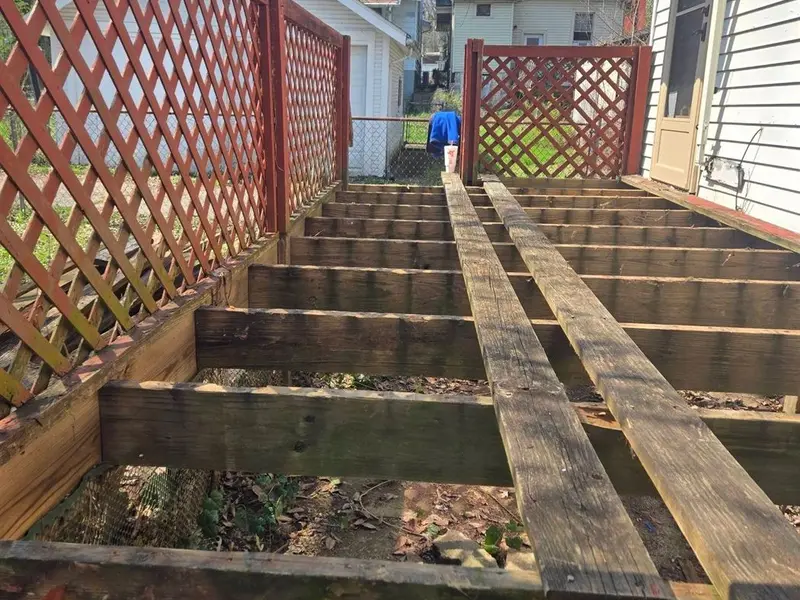
- The ledger first. The board bolting your deck to the house is the most failure-prone component on any deck. We check fastener type, flashing and the condition of the rim joist behind it.
- Framing, beams and posts. Probing for soft wood, checking post bases for ground contact, and looking at how the beams carry to the footings.
- Footings and stairs. Stair stringers resting on soil or a loose block instead of a proper footing are one of the most common things we find.
- Guards and handrails. Height, spacing and how solidly the posts are actually attached — many older decks fail here even when the frame is fine.
- Surface and finish. Board condition, fastener corrosion, drainage and whether the coating is still doing anything.
Then you get a written, itemized estimate with the repair-or-replace call made in plain language — plus whether your county requires a permit for the work. You can book that directly through our deck safety inspection service.
How do you decide whether a deck should be repaired or replaced?
The framing decides it, not the decking. If the joists, beams, posts and ledger are sound, almost everything above them is repairable — boards, railings, stairs and finish are all replaceable pieces on a frame that's doing its job. We lean toward replacement when the rot is in the structure rather than on it, when the original construction can't be brought up to current requirements without effectively rebuilding it anyway, or when the repair cost starts closing in on half the price of a new deck.
We tell you which of those you're looking at before any work is scheduled, and we'll show you what we're basing it on. If you want to understand the reasoning before we ever come out, we wrote it up in detail in our guide to repairing versus replacing a deck, and the cost page lays out what drives a repair quote up or down.
How should you vet any Maryland home improvement contractor?
This part is consumer education, not a sales pitch — it applies to every contractor you talk to, including us. Maryland treats deck work as home improvement under state business regulation, and there are protections worth knowing about before you sign anything.
- Look the company up. Maryland runs a public license lookup for home improvement contractors at labor.maryland.gov/pq/. It takes about a minute and it's the first thing an informed homeowner does.
- Know what the Guaranty Fund covers. Maryland's Home Improvement Guaranty Fund can compensate homeowners for actual losses from poor or incomplete work — but it covers work performed by licensed contractors only. Unlicensed work falls outside it.
- Know the limits. The fund pays up to $30,000 per claimant, with a $250,000 aggregate cap per contractor, and claims must generally be filed within three years.
- Get it in writing. A written, itemized scope protects you far more than a verbal number, and it's the only way to tell two quotes apart honestly.
- Ask who pulls the permit. Permit rules change at every county line around Baltimore, and the answer tells you a lot about how the company operates.
Where do you work?
From Lutherville-Timonium, at the I-695 and I-83 interchange, which puts most of the metro's deck-heavy neighborhoods inside a short drive. We work across Baltimore County, Howard County, Anne Arundel County, Harford County and Carroll County, and we handle rowhome rooftop decks in Baltimore City — a niche that needs its own knowledge, since a rooftop deck spans party wall to party wall on shared masonry rather than hanging off a ledger. See every area we serve, or start with the full range of deck repairs we handle.