Repair, in the large majority of cases — and it is almost always cheaper. The framing is the expensive half of a deck, and usually the half that has survived. Replacement earns its price in three situations only: framing rot spread through the structure rather than sitting in one or two spots, a deck that cannot be brought up to current code without being rebuilt, or a repair scope climbing toward half the cost of a new deck.
Almost everything else — grey splintered boards, a wobbly railing, creaking stairs, popped screws, rot at one corner — is a repair, and the deck under it has years left. The trouble is that the surface is what you see while the frame is what decides, so homeowners judge with the wrong evidence.
What actually decides it: framing condition versus surface condition
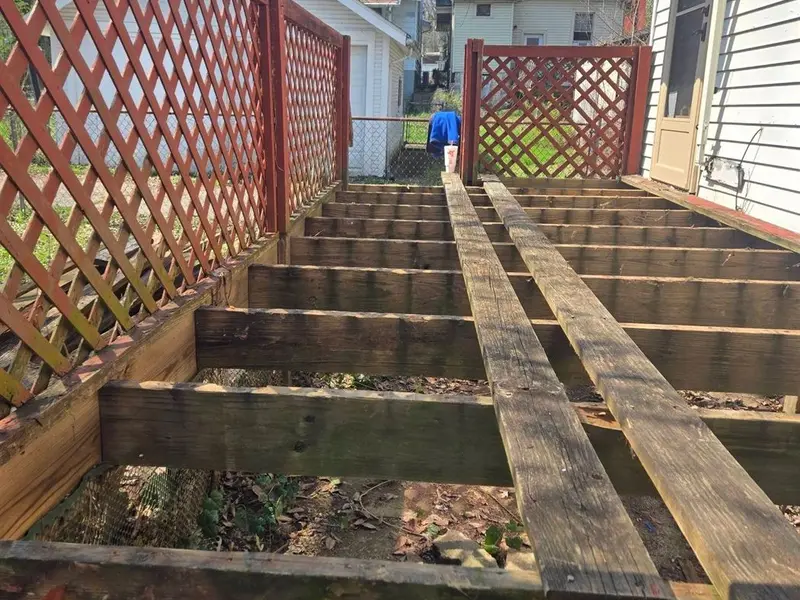
Split the deck in two. The surface is decking, railing infill, stair treads and finish. The frame is the ledger, joists, beams, posts and footings. They fail on different timelines and cost completely different money to put right.
| System | What it includes | What failure means |
|---|---|---|
| Surface | Decking, railing infill, treads, finish | Almost always a repair. The deck stays standing throughout. |
| Ledger | The board bolted to the house, plus flashing and hold-downs | A deck's most failure-prone connection — serious, usually repairable in isolation. |
| Joists | The members carrying the decking | One or two get sistered. A dozen is a different conversation. |
| Beams & posts | Carrying members and their columns | Repairable when localized. Post bases on soil or a patio block are a common find. |
| Footings | Concrete below frost depth | Expensive to correct later — everything above must be supported first. |
How do you tell whether the framing is sound?
You probe it. A screwdriver or awl pushed into a joist end, a post base or the band behind the ledger should stop within a few millimetres. If it sinks, that wood is gone however solid it looks. Probe the wet places:
- Joist ends at the ledger — where water past failed flashing has sat for years.
- Post bases — where a post meets concrete or soil. The code calls for a one-inch standoff above concrete at splash-exposed post bases, and wood within six inches of exposed ground must be ground-contact rated. Older decks routinely fail both.
- Beam tops — the flat surface where joists sit and debris collects.
- Stair stringer bottoms — often on soil or a block rather than a frost-depth footing.
- Anywhere permanently shaded — under a grill mat, behind a planter, beneath a stair run.
NADRA and InterNACHI name the same short failure list — ledger board, beams, support posts, hardware connections, railings and stairs — with ledgers the most failure-prone, particularly where nailed rather than bolted. Decks built here in the 1980s fail at the ledger for specific reasons.
When is repair the right call?
When the structure is doing its job and the problems are additive rather than systemic:
- The frame probes firm and the decking failed. New boards on a sound frame — deck board replacement and resurfacing — is the cheapest route to a deck that feels new.
- Rot is localized — a few joist ends, one post, a rim section. Structural and rot repair takes out the bad wood and leaves the rest.
- The railing or stairs are the problem. Guards and stair geometry reach current requirements without touching the frame: railing repair and stair and step repair.
- It is cosmetic. Grey, splintering wood is finish failure — washing and stripping then staining and sealing.
- It is out of code in fixable ways — guard height, baluster spacing, missing hold-downs, a nailed ledger, ungalvanized hardware.
When does replacement genuinely make sense?
We say it when it is true, and here is what makes it true:
- Framing rot is widespread. Not one joist — most of them. When the ledger, several joists and a post are soft at once, you are rebuilding a deck one member at a time at repair prices.
- The structure cannot be brought up to current code. Some older decks were built in ways the code does not permit: a ledger on brick or stone veneer, which is non-structural and a prohibited attachment; a ledger on cantilevered floor joists; footings never poured to frost depth. Correcting what a deck stands on means taking the deck off it.
- Repair cost approaches half the price of a new deck. Past that point, replacement buys a full service life and a warranty on the whole structure rather than on the patched parts of an old one.
A note on how this market behaves. Most companies doing deck work around Baltimore build decks — that is what their crews, pricing and schedules are built around — so a repair call very often comes back as a replacement quote. We repair; that is our bias and you should know it. The counterweight: we say plainly when a deck is past saving, because selling a repair that will not hold is worse for us than losing the job.
What does deck repair cost?
Every number below is a national figure from published research, not a Baltimore quote. Nationally, Fixr puts overall deck repair at $500 to $3,000 (average around $1,500), and Bob Vila reports an average of $2,019 within a typical range of $859 to $3,321. Baltimore-area pricing varies with access, deck height and framing condition — a second-storey deck over a hillside walkout is a different job from a low platform on flat ground.
| Work | National range | Source |
|---|---|---|
| Overall deck repair | $500–$3,000 (avg. $1,500) | Fixr |
| Overall deck repair | $859–$3,321 typical (avg. $2,019) | Bob Vila |
| Deck repair per square foot | $10–$55/sq ft | Fixr and Bob Vila |
| Rot repair | $300–$5,000 | Bob Vila |
| Sagging deck | $750–$10,000 | Bob Vila |
| Joist repair | $100–$300 each | Fixr and Bob Vila |
| Joist replacement | $150–$350 each | Fixr and Bob Vila |
| Post replacement | $200–$400 each | Fixr and Bob Vila |
| Footings | $300–$400 each | Fixr and Bob Vila |
| Flashing | $15–$30 per linear foot | Fixr and Bob Vila |
| Board replacement project | $500–$4,000 | Bob Vila |
| Resurfacing | $15–$50/sq ft | Bob Vila |
Notice what the structural lines do to the maths. Nationally, Fixr and Bob Vila both put joist replacement at $150 to $350 each. Baltimore-area pricing varies with access, deck height and framing condition — but the shape holds anywhere: three joists is a modest repair, twenty is most of a deck. That count moves a job into the replace column. Our deck repair cost page lists the published ranges by repair type.
One line item nobody publishes: there is no established national cost for ledger-board work. We price ledger repairs from the flashing, joist and rot work the job actually contains.
Get the Repair-or-Replace Answer in Writing
We probe the framing, photograph what we find and give you a straight recommendation — including "replace it," when that is the truth.
📞 Call (667) 239-8644 Get a Free EstimateA five-step decision framework you can run yourself
- Look underneath first — the frame decides, not the boards.
- Probe the five wet spots — joist ends, post bases, beam tops, stringer bottoms, permanent shade.
- Count, don't judge. How many members are soft? A number turns a bad feeling into a scope.
- Check the connections — ledger bolted or nailed, flashing, hardware corrosion, guards above 30 inches. A deck safety inspection covers it; so does the safety checklist.
- Apply the half-cost rule. Heading toward half the price of a new deck? Replace. Otherwise repair.
What changes the answer around the Baltimore metro
Housing stock and terrain move the odds, and we work out from Lutherville-Timonium at I-695 and I-83:
- Deck repair in Lutherville-Timonium — a median build year in the late 1950s and early 1960s, decks added a generation later and now 20 to 40 years old. Ledger and hardware condition decide those frames.
- Deck repair in Ellicott City — steep valley lots, so tall decks over walkouts are the norm, and height raises both the repair cost and the cost of getting it wrong.
- Perry Hall — a median build year of 1986, so original decks are at the end of their service life — and Columbia, where village covenants require an architectural committee application before deck construction.
Repair or replace: frequently asked questions
Is it cheaper to repair or replace a deck?
Repair is cheaper in the large majority of cases, because the framing — joists, beams, posts and footings — is the expensive half of a deck, and it is usually the half that survives. Nationally, Fixr puts overall deck repair at $500 to $3,000 with an average around $1,500, and Bob Vila reports an average of $2,019 with a typical range of $859 to $3,321. Baltimore-area pricing varies with access, deck height and framing condition. Replacement wins on cost only when the framing itself is failing across the structure, because then a repair is quietly paying for most of a new deck without delivering one.
How do I know if my deck framing is rotted?
Probe it. A screwdriver or awl pushed into a joist end, the bottom of a post, or the band behind the ledger should meet firm resistance within a few millimetres. If it sinks in, that wood is gone. Check the joist ends where they meet the ledger, the post bases where they meet concrete or soil, and the underside of the decking at the house wall — those are the wet spots. Soft boards underfoot tell you about the surface; they tell you nothing about the frame until someone looks underneath.
When is a deck too far gone to repair?
Three conditions push a deck past repair: framing rot that is widespread rather than localized, a structure that cannot be brought up to current code without effectively rebuilding it, and a repair scope whose cost approaches half of what a new deck would cost. Any one of those on its own is worth a hard conversation. Two of them together and we will tell you to replace, even though replacement is not the work we specialize in.
Can you replace deck boards without replacing the frame?
Yes, and it is one of the most common jobs we do. If the joists, beams, posts and ledger are sound, new decking can go straight onto the existing frame — that is what resurfacing means. The one rule is that the framing has to be inspected and any soft joists sistered or replaced before new boards cover them up, because nobody wants to pull up a brand new surface a year later to reach a joist that was already failing underneath it.
Why do deck companies always recommend replacement?
Because most companies in this market are deck builders. Building is what their crews, pricing and schedule are set up around, so a repair inquiry naturally comes back as a replacement quote. That is not always bad faith — it is what the business is built to sell. We repair, which is why our default answer is the opposite, and it is also why we say plainly when a deck genuinely is past saving instead of selling a repair that will not hold.
Does repairing a deck require a permit in the Baltimore area?
It depends on the county and on whether the work is structural. Baltimore County requires a permit for any deck more than 16 inches above grade or larger than 120 square feet, and repairs that touch framing, footings, guards or stairs are where permitting comes in. Howard County and Anne Arundel County both explicitly treat board-only replacement as ordinary repair needing no permit; Baltimore County's materials do not address it either way. Confirm your scope with your own county before work starts.
Before you sign anything
Get the permit picture straight too — the rules change at every county line. Start with Baltimore County's 16-inch and 120-square-foot trigger or Howard County permits and Columbia's village approval.
Repair First. Replace Only If It's Truly Needed.
Free inspection, a written estimate and photos of whatever we find underneath. If it can be saved, we'll save it — if it can't, we'll say so.
📞 Call (667) 239-8644 Request a Free Quote