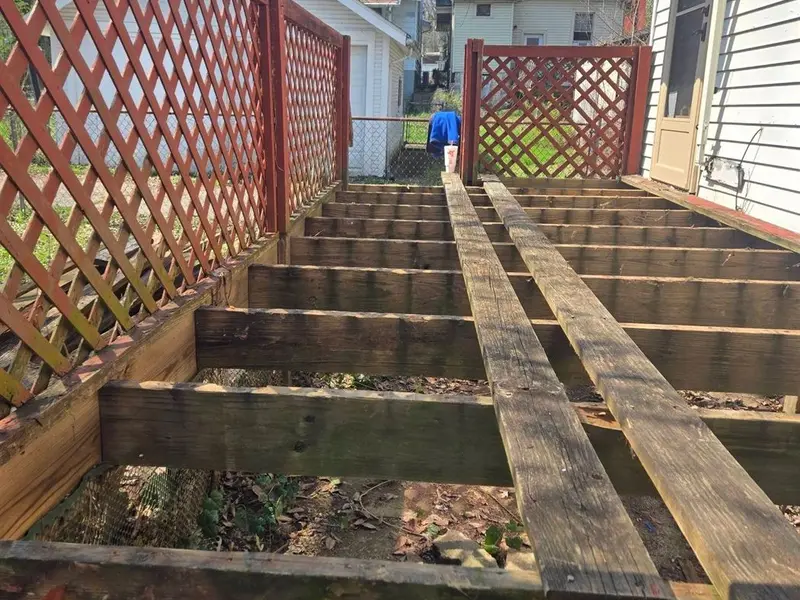
If you own a deck in Perry Hall, Maryland, there's a good chance it's the same age as your house — and that single fact shapes every repair we do here. The Deck Repair Wizard fixes decks in Perry Hall: rotted framing, failing ledger connections, loose guards, sagging stairs and finishes that gave up years ago. We don't build new decks, so nothing we find turns into a replacement quote by reflex.
Perry Hall is the Baltimore metro's 1980s deck boom, preserved
Most of our service area follows the same pattern: a mid-century house with a deck bolted on decades later. Perry Hall is the exception, and it's the reason this town is one of the strongest repair markets in Baltimore County.
The community went from 5,446 residents in 1970 to 29,409 in 2020. That's not gradual infill — that's a housing boom, and the median build year here is 1986. Roughly 45.3% of the housing is single-family detached, and on those houses the deck usually came with the house rather than after it. Which means:
- Your deck's age is your house's age. A 1986 build has a deck heading toward forty years old, not twenty.
- Whole streets fail on the same schedule. Same build year, same framing method, same fastener spec, same weather since. When a neighbor is getting deck work done, that's a reasonable prompt to look at yours.
- It was built to 1980s practice, not current code. That's the part that matters most.
What 1980s construction left behind
The ledger board — the piece attaching the deck to the house — is the most failure-prone component on any deck, and decks of this era were routinely fastened with nails instead of bolts, with no continuous flashing at the ledger-to-house connection. Forty years of Maryland rain then ran behind that board and into the rim joist where nobody could see it. The code now requires bolted attachment, continuous flashing at that connection, and lateral-load hold-downs rated to resist 1,500 pounds of tension at each end of the ledger. Very little in the 1986 housing stock has any of that.
The other standard findings on decks of this vintage: 4x4 posts bearing directly on soil or a patio slab rather than standing clear on a footing — the code calls for a one-inch standoff above concrete for weather- and splash-exposed post bases — and stair stringers resting on dirt or a loose block instead of a frost-depth footing. Both rot from the bottom up, invisibly, until someone leans or steps wrong. Here's the full anatomy of how an 80s deck fails at the ledger.
None of that means teardown. Pressure-treated southern yellow pine is generally credited with 10 to 15 years of service life with maintenance, and up to 15 to 25 years above ground when every field cut is resealed — but service life is a maintenance range, not an expiry date. We've corrected plenty of original 1980s ledgers, sistered the joists around them, reset the posts and put decks back into service. How we decide repair versus replace →
Maryland weather, applied to a forty-year-old deck
The Baltimore area takes roughly 45 inches of rain a year — the sum of the National Weather Service's 1991–2020 monthly normals at BWI — plus about 19.3 inches of snow. Through the winter the temperature swings above and below freezing repeatedly, so every bit of water sitting in a joint freezes, expands and levers that joint a little wider. Humidity runs near 75% from August through October, which is when algae and mildew take hold on shaded boards, and the freeze-free season runs past 230 days, giving decay fungus most of the year to work.
Horizontal deck boards hold standing water while vertical railings and skirting shed it, which is why the walking surface fails first and why re-staining a deck without dealing with the framing underneath is money spent on the wrong half of the problem.
Deck repairs we do in Perry Hall
- Structural and rot repair — ledger correction, joist replacement and sistering, post and beam repair.
- Deck board replacement — soft, cupped and splintering boards replaced and blended into the existing surface.
- Railing repair and code retrofit — guards rebuilt to current height and spacing requirements, which almost no original 1980s railing meets.
- Stair and step repair — stringers, treads, handrails and proper footings.
- Restoration, power washing and stripping, staining and sealing — done in the right order, after the repairs.
- Deck safety inspection — ledger, framing, posts, footings, railings and stairs, documented with photos and a written punch list.
- Composite and Trex repair for the newer builds — composite is low-maintenance, not no-maintenance.
On finish timing, how often a Maryland deck actually needs re-staining is worth five minutes before you buy another gallon of anything.
Baltimore County permit rules for Perry Hall decks
Perry Hall is unincorporated Baltimore County. The county's threshold is stricter than the rule of thumb almost everyone repeats:
- A permit is required for any deck more than 16 inches above grade or larger than 120 square feet. Not 30 inches — that's the national figure people assume, and it's wrong here. A 10-by-12 deck is already over the square-footage trigger.
- No exemption applies in a Historic District, on the Landmarks List, in a floodplain or in the Critical Area.
- Inspections are footing, framing and completion — the framing inspection happens before decking covers the structure, which is why sequencing matters on a rebuild.
- Baltimore County adopted the 2021 IRC effective September 3, 2024, and county deck-guide documents predate that adoption — confirm current span tables with the county.
- Board-only replacement isn't addressed as an exemption in Baltimore County the way it is in Howard County, so we never assume it's exempt.
- Staining, sealing and power washing are not addressed in any county's permit materials — that's the accurate statement rather than a promise that no permit is needed.
Technically, the county calls for footings at a 30-inch frost depth, minimum 10-inch thickness and 3,000 psi concrete, with footings within 3 feet of the house wall bearing at the same elevation as the house foundation; AWPA-treated southern pine #2 or better, ground-contact rated in soil contact; bolted attachment rather than nails; triple-dip galvanized or stainless hardware; and 6x6 posts limited to 12 feet. Full Baltimore County deck permit guide →
Where we work in Perry Hall
We cover the whole Perry Hall area — the older streets historically centered on US-1 (Belair Road) and Forge Road, the Germantown and North Perry Hall sections, and the newer Honeygo area, which shows up in the data as one of the wealthier pockets of the community alongside ZIP 21162. ZIP 21128 runs a median household income of $128,069.
For orientation, the landmarks people give us are the Perry Hall Mansion, on the National Register since 1980, and the Perry Hall Library (1963). The Perry Hall Improvement Association has been at this since 1945. Most of our calls come from families in the Perry Hall High, Perry Hall Middle and Perry Hall Elementary areas, plus Seven Oaks Elementary and Joppa View Elementary.
We serve the neighboring Baltimore County areas under the same permit rules: Kingsville and Towson, and we're based a short run west in Lutherville-Timonium.