What is deck board replacement — and do you need it or a whole new deck?
Deck board replacement means pulling the failed decking off your existing frame and installing new boards in their place, either in spots or across the whole surface. If your deck's joists, beam, posts and ledger are sound and the problem is the part you walk on, this is the repair you need — not a new deck. It is the single most common reason people call us, and the single most common repair that gets quoted as a replacement by somebody else.
There is a straightforward physical reason the surface fails first: horizontal boards hold standing water while vertical faces shed it. Add leaf and pine-needle debris that blocks sunlight and traps moisture, and the top of your deck absorbs a beating the framing never sees. On a lot of 25-year-old Baltimore-area decks, the boards are shot and the frame underneath is fine.
Signs your deck boards need replacing
- A screwdriver sinks into the board. Soft or spongy wood is gone; no amount of sanding or stain brings it back.
- Cracks running the length of the board or splitting out through a fastener hole.
- Cupping. The board has curled into a shallow trough that now holds water after every rain, which accelerates everything else.
- Splintering that keeps coming back after sanding — the surface fibers have broken down from years of ultraviolet exposure. The USDA Forest Products Laboratory documents that wood is rapidly degraded by short-wavelength UV, with additional subsurface degradation from longer-wavelength light.
- Soft undersides. Reach under an accessible board and press. The underside dries slowest and often fails before the top shows anything.
- Boards that flex or creak underfoot — sometimes the board, sometimes the joist beneath it, which is why we check both.
- Fasteners that won't stay put. Popped screws and backed-out nails mean the wood around them has lost its grip.
- Black or green film that returns within weeks of cleaning, a sign the board is holding moisture rather than shedding it.
Partial replacement or full resurfacing — which do you need?
Two different jobs, and the difference is money.
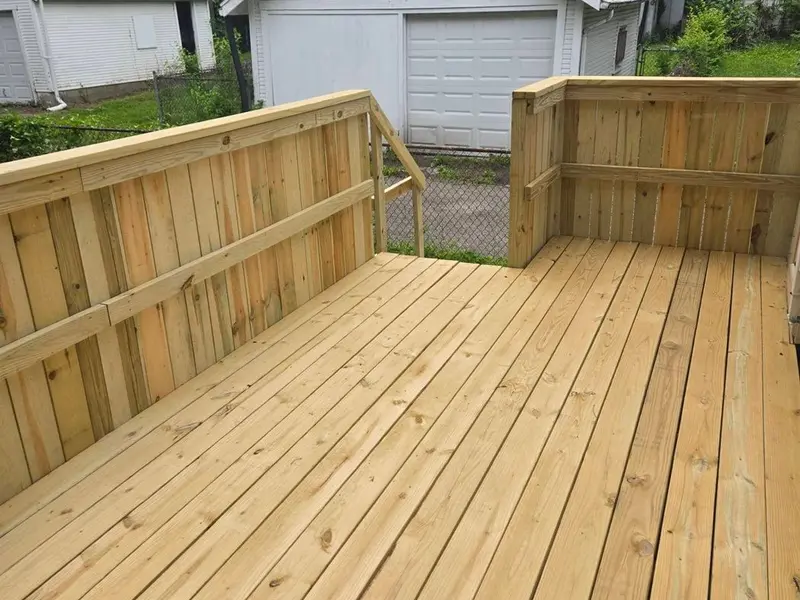
- Partial board replacement is right when fewer than roughly a quarter of the boards have failed and the rest still have life. We pull the bad ones, inspect the joists underneath, replace what needs replacing and blend the new boards into the field.
- Full resurfacing — sometimes called re-decking — strips the entire walking surface and usually the railing, then installs a new surface on the existing frame. It costs far less than a new deck because the footings, posts, beam and joists stay put, and in most counties the permit picture is simpler as a result.
The line between them is not aesthetic. If we lift boards and find joists that have lost section, hangers that have corroded through, or a ledger that was nailed rather than bolted, the honest answer is that the frame comes first — see deck structural and rot repair. Putting a beautiful new surface on a failing frame is the most expensive mistake homeowners make with a deck.
What's included in a board replacement
- Free inspection and board count. We probe the decking, check the framing beneath, and tell you whether you're looking at eight boards or a resurface.
- Written estimate with the board species, fastening method and finish plan spelled out, plus whether your county requires a permit for the scope described.
- Removal. Failed boards come up and the joist tops are exposed and inspected — this is the only moment in a deck's life when the framing is easy to see, so we use it.
- Joist preparation. Any soft joist tops are addressed. Where we're re-decking, joist tape over the joist tops is worth discussing, because most joist rot starts at the fastener holes on the top edge.
- Installation. New boards set with consistent spacing for drainage and expansion, fastened with hardware rated for contact with modern treated lumber. Hidden fastener systems are an option on grooved composite and some hardwoods; face-screwing is the workhorse on pressure-treated pine.
- Trim, edges and transitions so the repair doesn't read as a patch at the stair landing or the ledger.
- Finish scheduling. New treated lumber arrives wet. We schedule staining and sealing once the wood is dry enough to take it, rather than sealing in the moisture.
What boards should you use?
| Material | What to expect | National material cost |
|---|---|---|
| Pressure-treated southern yellow pine | The regional default. Industry service-life range of roughly 10–15 years with maintenance, 15–25 above ground when every field cut is resealed, under 10 if never sealed. | Low end of the $3–$45/sq ft band |
| Western red cedar | Better looking, softer, and unforgiving about ground contact and standing water. | $25–$55/sq ft installed |
| Ipe / mahogany (red balau) | Very dense and durable; greys out quickly without finish; needs pre-drilling and stainless fasteners. | Upper end of the range |
| Composite (including Trex) | No rot at the surface, but the treated-pine frame below still rots. Older generations of composite were the subject of a 2009 lawsuit alleging susceptibility to mold, mildew, spotting and surface flaking; the manufacturer denied the allegations and settled. | $12–$45/sq ft installed |
One detail that matters more than the species you pick: every field cut in pressure-treated lumber exposes untreated wood. Cut ends that never get a brush of end-cut preservative are where rot starts on a deck that is otherwise well built. If you have composite, read composite and Trex deck repair before you buy a repair kit.
What does deck board replacement cost?
No Maryland-specific published pricing exists for this work. Every figure below is a national average from Fixr or Bob Vila.
| Scope | National range | Source |
|---|---|---|
| Board replacement project | $500–$4,000 | Bob Vila |
| Board replacement, per sq ft | $15–$55 | Fixr |
| Floor board repair, per sq ft | $10–$35 | Bob Vila |
| Deck resurfacing, per sq ft | $15–$50 | Bob Vila |
| Materials only, per sq ft | $3–$45 | Both |
| Cracked boards (small repair) | $150–$500 | Bob Vila |
| Creaky or squeaking boards | $150–$600 | Bob Vila |
| Popped screws / missing nails | $100–$200 | Bob Vila |
| Holes in decking | $150–$500 | Bob Vila |
What moves your number: board species and width, deck height (anything above a walkout changes the labor), access for getting long boards into a fenced back yard, how many joists need work once the surface is off, and whether you want the deck refinished as part of the job.
Does board replacement need a permit around Baltimore?
Only two jurisdictions here address it directly, and the difference is worth knowing before you call anyone:
- Howard County treats board-only replacement as ordinary repair — no permit.
- Anne Arundel County likewise requires no permit for board-only replacement.
- Baltimore County, Harford, Carroll and Baltimore City do not address board-only replacement in their published materials. Don't assume parity. Baltimore County's general trigger is any deck more than 16 inches above grade or over 120 square feet, with no exemption in a historic district, floodplain or Critical Area, and Baltimore City publishes no deck exemption at all.
If you're in a Columbia village there is a second layer: every property is under recorded covenants, and exterior alterations go through the village architectural committee before work starts. Our Howard County permit and Columbia village approval guide walks through both, and the Baltimore County deck permit guide covers the 16-inch rule most homeowners have never heard of.
Why hire a local pro for deck boards?
Because the boards are the easy part and the joists are the point. Pulling decking is the one opportunity you get to see the framing without paying for demolition — a crew that just screws new boards down over whatever is there has thrown that opportunity away, and you will pay for it in five years when the fasteners start pulling out of soft joist tops.
Working from Lutherville-Timonium puts most of the metro's deck-heavy neighborhoods inside a short drive, and the housing stock tells us what to expect before we arrive. In Lutherville-Timonium and Catonsville the houses date to the late 1950s with decks added decades later. Fallston is 99.4 percent detached homes with a median build year of 1977 — a lot of original decking still in service. Severna Park and Arnold sit between rivers under heavy canopy, which means shade, damp and boards that grow algae on the north half of the deck.
If you're still weighing whether new boards are worth it on an old frame, read how to decide between repairing and replacing a deck — or book a free deck safety inspection and get a written punch list first.