What is deck repair, and does your deck need it?
Deck repair means fixing the parts of an existing deck that have worn out or come loose — decking boards, fasteners, framing and joists, the ledger connection at the house, posts and footings, railings and stairs — while leaving the rest of the deck in place. If your deck still stands level, the posts sit on real footings, and the damage is limited to the surface, hardware or a handful of framing members, you almost certainly need a repair rather than a replacement. Most Baltimore-area homeowners who have been quoted a new deck were quoted one by a company that builds new decks for a living.
That is the whole reason this business exists. The Deck Repair Wizard – Baltimore repairs decks; we don't sell new ones. We'll fix what can be fixed, and when a deck genuinely is past saving, we tell you so in plain language instead of padding a quote.
Why do decks fail in the Baltimore area?
Age plus weather. Most decks across this metro went up between the 1980s and the 2000s on houses that were already decades old — in Lutherville-Timonium the median house dates to around 1958 and 1964, with the deck added later. That puts a huge share of local decks between 20 and 40 years old, which is exactly the age where pressure-treated framing and old connection hardware start to give out. The industry group NADRA estimates that roughly 30 million of the 60-plus million decks in the United States are past their recommended service life and that fewer than half were built to code.
Maryland's climate accelerates all of it. The National Weather Service's 1991–2020 monthly normals for BWI add up to about 45 inches of precipitation a year, with roughly 19 inches of snow, and temperatures swing above and below freezing repeatedly through the winter. Every one of those swings drives water into a joint, freezes it, and pries the joint a little wider. Humidity sits near 75 percent from August through October, so shaded framing never fully dries out. And because horizontal boards hold standing water while vertical faces shed it, the walking surface always shows damage first — even when the more serious problem is underneath.
Signs your deck needs repair now
- Movement or a gap at the house. Any sway when you walk, or daylight opening between the deck and the siding, points at the ledger connection — the most failure-prone part of a deck.
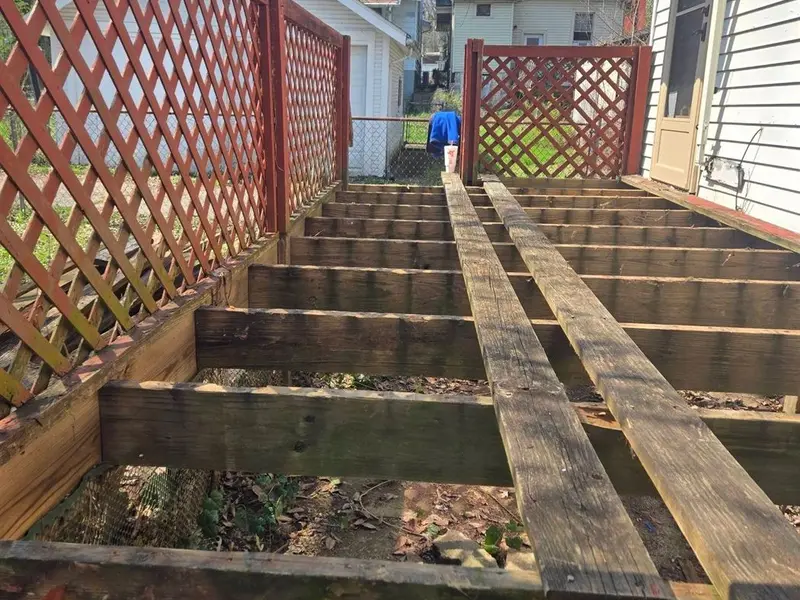
- Soft wood you can push a screwdriver into. Check post bases, stair stringers and joist ends near the house. If the tool sinks, that wood is structurally gone.
- Railings that flex when you lean. Guard posts loosen and rot at the connection long before the railing looks bad.
- Rust streaks and popped fasteners. Black or orange staining around screws and bolts means the hardware is corroding and the wood around it is staying wet.
- Bounce underfoot. A springy feel means joists have lost section to rot, are over-spanned, or have pulled off their hangers.
- Water soaking in instead of beading. Splash water on the boards in spring. If it darkens the wood rather than beading up, the finish has failed and the deck is absorbing every rain.
- Green or black film. Green algae signals persistent wet shade; black streaking is mildew. Both are slip hazards and both mean moisture is sitting on the surface.
The US Consumer Product Safety Commission recorded roughly 224,000 people injured in deck and porch incidents between 2003 and 2007, about 33,000 of them from structural failure or collapse. If your deck is doing two or more of the things above, stop using it until it has been looked at — a free deck safety inspection costs you nothing.
What's included in a deck repair?
Every deck is different, but the work falls into six buckets. We diagnose all six on the first visit, even if you only called about one.
- Decking and surface. Cracked, cupped, splintering or spongy boards pulled and swapped, fasteners upgraded, and new boards blended into the existing field so the deck doesn't look patched. See deck board replacement.
- Framing and structure. Rotted joists sistered or replaced, beams supported, hangers and connectors corrected, sagging corrected. See deck structural and rot repair.
- The ledger connection. The single most important repair on most older decks: opening up the ledger, checking for bolts rather than nails, and correcting the flashing the code requires at the ledger-to-house joint.
- Posts and footings. Rotted post bases cut back and reset, standoff hardware added, undersized or missing footings addressed.
- Railings and guards. Loose posts re-anchored and spacing brought in line with current requirements. See deck railing repair and code retrofit.
- Stairs. Treads, stringers, handrails and the footing under the bottom of the stringer. See deck stair and step repair.
Restoration work — power washing and stripping, staining and sealing, and waterproofing — usually follows the structural repairs, because there is no sense putting finish on boards that are about to come out.
How a deck repair job actually goes
- You call or send the form. Describe what the deck is doing and send photos if you have them. We'll tell you on the phone whether it sounds like a surface fix or something structural.
- Free on-site inspection. We check the ledger, framing, hangers, posts, footings, guards and stairs — not just the part you noticed — and show you what we find.
- Written, itemized estimate. You get the repair-or-replace call in writing, along with whether your county requires a permit for the work described.
- Permit and scheduling, if applicable. Structural work in most of these counties triggers footing, framing and final inspections, which sets the schedule.
- The repair. Treated lumber rated for its exposure, hardware rated for treated wood, and framing connections done with bolts and structural screws rather than nails.
- Walk-through and clean-up. We show you each repair, haul the debris, and leave the workmanship warranty in writing.
What materials do we repair?
Nearly every deck in this market is framed in pressure-treated southern yellow pine. Surfaces vary more:
- Pressure-treated pine. The industry range from the Southern Pine Council puts service life around 10 to 15 years with maintenance, up to 15 to 25 years above ground when every field cut is resealed, and under 10 years when a deck is never sealed at all. Field cuts matter more than most homeowners realize — cutting a treated board exposes untreated wood.
- Western red cedar. Handsome, softer, and unforgiving about ground contact; cedar decks in wooded lots around Ellicott City and Fallston tend to fail at the stair stringers and post bases first.
- Ipe and mahogany (red balau). Dense hardwoods that hold up well but grey out fast without finish, and that need pre-drilled, stainless fastening when boards are replaced.
- Composite, including Trex. The boards resist rot; the treated-pine framing under them does not. See composite and Trex deck repair.
Wherever wood sits within six inches of exposed ground or gets embedded in concrete, the code calls for ground-contact-rated material — one of the most commonly ignored details on decks built 20 or 30 years ago.
What does deck repair cost in the Baltimore area?
No Maryland-specific published deck repair pricing exists. Every figure below is a national average from Fixr or Bob Vila, given so you can sanity-check a quote — not a Baltimore price.
| Repair | National range | Source |
|---|---|---|
| Whole deck repair project | $500–$3,000 (avg. $1,500) | Fixr |
| Whole deck repair project | $859–$3,321 (avg. $2,019) | Bob Vila |
| Per square foot, all-in | $10–$55 | Both |
| Rot repair | $300–$5,000 | Bob Vila |
| Sagging deck | $750–$10,000 | Bob Vila |
| Cracked boards | $150–$500 | Bob Vila |
| Creaky or squeaking boards | $150–$600 | Bob Vila |
| Popped screws / missing nails | $100–$200 | Bob Vila |
| Mold or mildew treatment | $200–$600 | Bob Vila |
| Joist repair / replacement | $100–$300 / $150–$350 each | Both |
| Post replacement | $200–$400 each | Both |
| Footing | $300–$400 each | Both |
| Flashing | $15–$30 per linear foot | Both |
| Railing repair | $25–$100/lf (Fixr) · $35–$210/lf (Bob Vila) | Both |
| Step repair | $15–$50 per step | Both |
What actually drives your number up: height above grade (anything you can't reach from a ladder changes the labor), tight side-yard access, framing that has to be opened before it can be priced, hardwood or composite surfaces, and any work that triggers a permit and inspection sequence.
Do you need a permit to repair a deck here?
Maybe — and the answer changes at every county line. Most homeowners have heard the "under 30 inches doesn't need a permit" rule. Around Baltimore that is wrong more often than it's right.
| Jurisdiction | Permit trigger | Board-only replacement |
|---|---|---|
| Baltimore County | More than 16" above grade or over 120 sq ft; no exemption in a historic district, Landmarks List, floodplain or Critical Area | Not addressed |
| Howard County | Only under 25 sq ft is exempt — no height exemption | No permit — treated as "ordinary repair" |
| Anne Arundel County | Detached only: under 200 sq ft and under 3 ft and outside the Critical Area. Attached decks always need a permit | No permit |
| Harford County | No numeric exemption published; permits required for new structures including decks | Not addressed |
| Carroll County | No numeric exemption published | Not addressed |
| Baltimore City | No deck exemption at all | General "ordinary repairs" language only |
Staining, sealing and power washing are not addressed in any of these counties' permit materials — which is not the same as "no permit needed," and we'd rather say that accurately than guess. For the full picture, read our Baltimore County deck permit guide or, if you're in a Columbia village, the Howard County permit and village architectural approval walkthrough.
Why hire a deck repair specialist instead of a general contractor?
Because the failure points on a deck are specific, hidden, and easy to paint over. A handyman can replace five boards; the question is whether the joists under those boards have lost half their thickness, whether the ledger was nailed to a brick veneer that the code does not accept as a structural attachment, and whether there is flashing above that ledger at all. Those are the failures that put people on the ground.
Working out of Lutherville-Timonium at the I-695 and I-83 interchange also means we cross four county lines in a normal week — Towson, Cockeysville and Hunt Valley and Perry Hall in Baltimore County, Ellicott City and Columbia in Howard County, Severna Park, Arnold and Crofton in Anne Arundel County, Bel Air and Fallston in Harford County, and Eldersburg in Carroll County. We know which rules follow which address, and we know that a deck in Ellicott City built tall over a walkout on one of the town's seven hills is a different repair from a flat-lot deck in Crofton.
Still weighing the big decision? Our guide on whether to repair or replace your deck lays out the exact thresholds we use — and why so many 1980s decks fail at the ledger explains the failure we find most often.