What is structural deck repair?
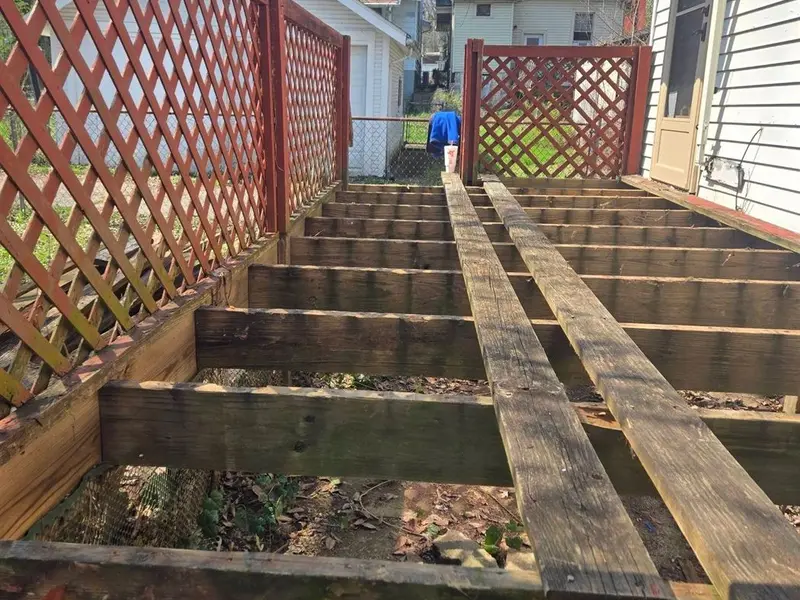
Structural deck repair is work on the frame — the joists, beam, ledger board, posts, footings and connecting hardware that hold the deck up — as opposed to the boards and railings you can see. You need it when the deck moves, bounces, sags, pulls away from the house, or when a screwdriver sinks into wood that ought to be solid. This is the highest-stakes repair on any deck and the one most often missed, because almost all of it happens where nobody looks.
It is also the repair most likely to get turned into a replacement quote by somebody else. A company that builds decks for a living has every reason to tell you the frame is finished. We only repair decks, so when we say a frame can be saved, that is the whole of the recommendation — and when we say it can't, that's the whole of that too.
Signs your deck framing is failing
- The deck sways or bounces when you walk across it, or you can feel it move when someone else does.
- A gap is opening between the deck and the house, or the deck has visibly dropped on the house side.
- Dark staining or peeling siding on the wall directly under the deck — water has been getting behind the ledger.
- A screwdriver sinks into the wood at joist ends, post bases or stair stringers.
- Rust streaks running down from bolts, joist hangers or nails, which means the hardware is corroding and the wood around it is wet.
- Joist hangers that are empty, bent, or nailed with the wrong fasteners — roofing nails and drywall screws show up in hangers far more often than they should.
- Posts sitting directly on concrete or in soil with no standoff — the code calls for a one-inch standoff above concrete on weather- and splash-exposed post bases, and for ground-contact-rated material wherever wood is within six inches of exposed ground or embedded in concrete.
- A visible dip or sag along the outer beam or in the middle of the field.
The ledger board: why it's the first thing we look at
The ledger is the board bolted flat against your house that carries roughly half the deck's weight. Deck industry and home-inspection groups consistently rank it as the most failure-prone component on a deck, ahead of beams, posts, hardware, railings and stairs. The reason is simple: it sits tight against the house where water collects, and for two decades it was routinely installed wrong.
Here is what we check, and what the code requires:
- Bolts, not nails. Baltimore County's own deck specifications state that decks are to be attached with bolts rather than nails. A nailed ledger is the defining flaw of 1980s and 1990s decks in this market — here's what that failure looks like in detail.
- Correct fastener spacing. The code sets ledger fastener spacing by joist span, from six to eighteen feet, and by lumber species, in staggered rows. Fasteners "about every 16 inches" is not a specification.
- Continuous flashing. The code requires continuous flashing at the ledger-to-house connection. On older decks it is frequently absent, or it is a strip of aluminum tucked in behind nothing.
- Lateral load hold-downs. The code calls for 1,500 pounds of tension resistance at each end of the ledger — either two hold-down devices rated at 1,500 pounds or more within 24 inches of each end of the deck, or four rated at 750 pounds or more. These are in addition to the ledger bolts, not a substitute for them.
- What the ledger is attached to. The code does not accept cantilevered floor joists, brick or stone veneer, or an engineered I-joist rim without the manufacturer's reinforcement as a structural attachment. In a market full of brick houses, that prohibition matters — a ledger lagged into brick veneer is not attached to the structure of the house at all.
There is no published cost line item anywhere for ledger board replacement — so when a quote gives you a confident flat number for it sight unseen, ask what it's based on. We price ledger work after opening it up, from the flashing, joist and rot ranges, and we show you what's behind the board before we quote it.
What structural deck repair includes
- Joist repair and sistering. Where an otherwise sound joist has rot at one end, a full-length sister joist is fastened alongside it so the new member picks up the load and bears properly at both ends.
- Joist replacement. When rot runs the length of a joist or the top edge has gone soft under the decking, the joist comes out. Decking above is lifted and reset rather than destroyed wherever the boards allow it.
- Ledger repair or replacement with correct bolting, staggered fastener layout, continuous flashing and lateral hold-downs.
- Beam support and sag correction. The deck is supported, the cause of the sag is corrected, and the frame is brought back to level — not jacked and left.
- Post replacement. Rotted posts cut out and replaced in ground-contact-rated material, set on standoff bases so the end grain is never sitting in water.
- Footing work. Undersized, shallow or missing footings addressed. Baltimore County specifies footings at 30 inches for frost depth, a minimum 10-inch thickness, and 3,000 psi concrete, with footings within three feet of the house wall bearing at the same elevation as the house foundation.
- Hardware correction. Joist hangers and connectors replaced with properly rated fasteners. Baltimore County specifies triple-dip galvanized or stainless hardware — ordinary fasteners corrode fast in contact with modern treated lumber.
Once the frame is sound, the surface work makes sense: deck board replacement for the boards that came up, then railing repair and staining and sealing to protect what you just paid to fix.
How we sequence a structural repair
- Free inspection. We probe the framing, check hangers and bolts, look behind the ledger where access allows, and sight the beam for sag. You get photos of what we find.
- Written scope. Itemized, with the parts we can price confidently separated from the parts that can only be priced once opened up. No surprise change orders dressed up as discoveries.
- Permit determination. We tell you whether your county requires a permit and which inspections apply — footing, framing and completion in Baltimore County; footing, framing and final in Howard, Anne Arundel, Harford and Carroll; footing and final in Baltimore City.
- Shoring and demolition. The deck is temporarily supported so nothing moves while the failed members come out.
- Repair and rebuild in place. Ground-contact-rated lumber where it belongs, correct hardware, correct flashing.
- Inspection and close-in. Where a permit applies, framing is inspected before the decking goes back down.
- Walk-through. We show you every repair and leave the workmanship warranty in writing.
What structural deck repair costs
There is no Maryland-specific published pricing for this work. Everything below is a national average from Fixr or Bob Vila, offered as a sanity check on any quote — not a Baltimore price.
| Item | National range | Source |
|---|---|---|
| Rot repair (project) | $300–$5,000 | Bob Vila |
| Sagging deck (project) | $750–$10,000 | Bob Vila |
| Termite damage (project) | $500–$10,000 | Bob Vila |
| Joist repair | $100–$300 each | Both |
| Joist replacement | $150–$350 each | Both |
| Post replacement | $200–$400 each | Both |
| Footing | $300–$400 each | Both |
| Flashing | $15–$30 per linear foot | Both |
| Ledger board replacement | No published figure exists — quoted on inspection | — |
Height above grade is the biggest multiplier on structural work — a deck you can walk under is straightforward, and a second-story deck over a walkout basement is not. Tight side-yard access, footings that have to be dug by hand, and framing that can only be scoped after demolition all move the number.
Why a repair specialist, not a deck builder
Structural deck repair is diagnostic work before it is carpentry. The question is never just "is this board rotted" — it's whether the beam under it settled, whether the footing under that was ever poured to frost depth, and whether the ledger holding the whole thing to the house is bolted into framing or lagged into veneer. Get the diagnosis wrong and you spend real money on a deck that fails again in the same place.
We work this out of Lutherville-Timonium, which puts us across four county lines in a normal week — Lutherville-Timonium and Perry Hall in Baltimore County, where the housing stock is old enough that most decks are second-generation additions; Ellicott City, where decks are built tall over walkouts on the town's steep valley lots; and Fallston and Kingsville, where nearly every house is detached and nearly every deck is on a wooded lot that never dries out. Terrain changes the failure pattern, and we quote what we actually find.
Not sure whether you're looking at a repair or a rebuild? Read how we decide whether to repair or replace a deck, or start with a free deck safety inspection and a written punch list.