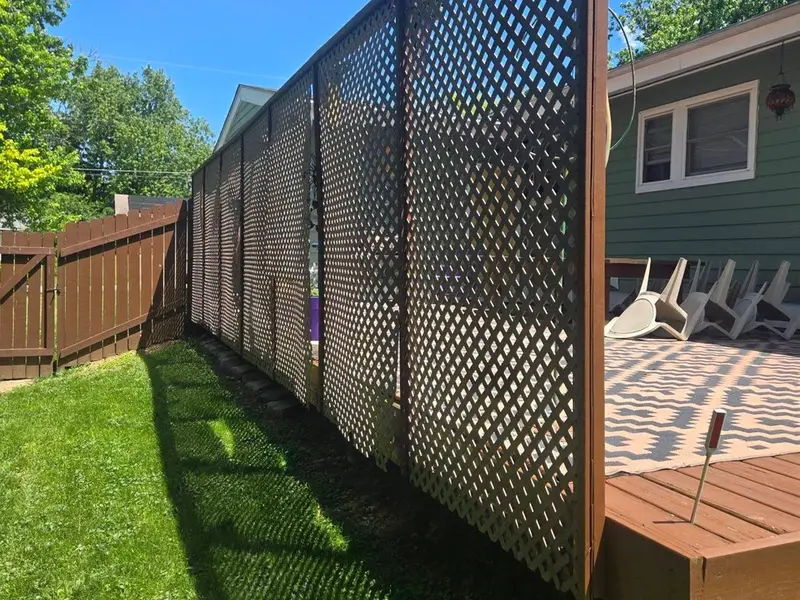
Kingsville, Maryland has one of the highest concentrations of deck-bearing housing anywhere in our service area, and The Deck Repair Wizard works here for exactly that reason. About 93.5% of homes in Kingsville are single-family detached — a figure almost nowhere else in Baltimore County matches — and the median build year is 1976. Detached house, back yard, back door: that combination almost always means a deck, and a 1976 house has had five decades for one to be built, weathered and neglected.
What a 93.5% detached, 1976-median town means for decks
Run the arithmetic and Kingsville comes out as a repair market rather than a replacement market. Nearly every property has a deck or has had one. Very few of those decks are new. And the ones that were added during the 1980s, 1990s and 2000s — the era when a wood deck was the standard backyard upgrade — are now 20 to 40 years old.
Age matters because of what it does to the parts you can't see. Pressure-treated southern yellow pine is generally credited with a 10 to 15 year service life with maintenance, up to 15 to 25 years above ground when every field cut is resealed, and under 10 years if it's never sealed at all. Treat those as industry ranges, not guarantees. Either way, a deck that's been standing since the 1980s has outlived its unmaintained window several times over — and is usually still standing on the strength of framing that's due for attention.
Here's the part that separates a repair company from a builder: outliving a service-life range is not the same as being finished. The boards are the cheapest and most replaceable part of a deck. What decides whether you repair or replace is the ledger, the joists, the beams and the post bases. We check those before we quote anything. This is how we make the repair-or-replace call.
Where decks fail, in order. The industry consensus — NADRA and InterNACHI both — puts it as ledger board first, then beams, support posts, hardware connections, railings and stairs. Ledgers are the most failure-prone of all, especially where they were nailed rather than bolted. Meanwhile NADRA estimates roughly 30 million of the 60-plus million decks in the United States are past their recommended service life, and that fewer than half of all decks were built to code. Here's the checklist for telling whether yours is one of them.
What Maryland weather does to a Kingsville deck
Nothing about the climate here is gentle on wood left outdoors. The Baltimore area takes roughly 45 inches of rain a year — the sum of the National Weather Service's 1991–2020 monthly normals at BWI — and about 19.3 inches of snow. Through the winter, temperatures swing above and below freezing repeatedly, and every one of those swings freezes the water sitting in a joint, expands it, and opens the joint a little wider for the next rain.
Then the growing season does its share. Humidity sits near 75% from August through October, the freeze-free season runs past 230 days, and decay fungus works every one of them. Add leaf and needle debris — which blocks the sunlight that would otherwise dry the boards — and you get the pattern every homeowner here recognizes: green algae and black mildew streaking on the shaded half of the deck, a faded and furred surface on the sunny half, and soft wood wherever two pieces of lumber meet and hold water.
Ultraviolet light does the cosmetic damage. The USDA Forest Products Laboratory documents that wood is rapidly degraded by short-wavelength UV, with additional subsurface degradation from longer-wavelength violet and visible light — which is why an unfinished deck greys from the top down, and why a finish is protection rather than decoration. On when to schedule that work: how often a Maryland deck really needs re-staining.
The work we do in Kingsville
- Deck safety inspection — ledger, framing, posts, footings, railings and stairs, with photos and a written punch list. On a deck of this age it's the right first move.
- Structural and rot repair — joists sistered or replaced, soft ledgers corrected, sunken posts reset, sagging framing brought back to level.
- Deck board replacement — soft, cracked and cupped boards swapped and blended into the existing surface.
- Railing repair and code retrofit — guards that move under a lean, rebuilt to current height and spacing requirements.
- Stair and step repair — stringers, treads, handrails and proper frost-depth footings under them.
- Full restoration with power washing and stripping and staining and sealing — always after the structural work, never instead of it.
- Waterproofing and flashing repair where water is getting into the framing or onto what's below.
Baltimore County permit rules that apply in Kingsville
Kingsville sits in Baltimore County, and the county's permit trigger is one of the strictest in the metro:
- A permit is required for a deck more than 16 inches above grade, or larger than 120 square feet. Most homeowners have heard the 30-inch rule. That's a national rule of thumb — it is not Baltimore County's rule, and the gap between 16 and 30 inches catches a great many ordinary back-door decks.
- No exemption exists in a Historic District, on the Landmarks List, in a floodplain or in the Critical Area.
- Inspections are footing, framing and completion. Framing is inspected before decking covers it.
- The county adopted the 2021 IRC effective September 3, 2024. Older county deck-guide PDFs predate that, so confirm current span tables with the county rather than trusting a downloaded document.
- Baltimore County doesn't publish a board-only-replacement exemption the way Howard County does, so we don't assume one applies to your job.
- Staining, sealing and power washing are not addressed in any county's permit materials. We state it that way on purpose — it's accurate, and "no permit needed" isn't.
Specifications worth knowing before you compare quotes: footings to a 30-inch frost depth, minimum 10-inch thickness, 3,000 psi concrete, with footings within 3 feet of the house wall bearing at the same elevation as the house foundation; AWPA-treated southern pine #2 or better, ground-contact rated anywhere it touches soil; decks attached with bolts, not nails; triple-dip galvanized or stainless hardware; 6x6 posts limited to 12 feet. The full Baltimore County deck permit guide is here →
One caution worth flagging: county rules stop at the county line. If your address turns out to be in Harford County rather than Baltimore County, the picture changes — Harford publishes no numeric exemption at all, and permits are expected for new structures including decks. Our Fallston and Bel Air pages cover that side.
Nearby areas we serve
We cover Kingsville from our base in Lutherville-Timonium, and we work the neighboring Baltimore County communities under identical rules — Perry Hall, where the median build year of 1986 produced a whole generation of original decks, and Towson. Wherever you are in the county, the permit thresholds and the inspection sequence are the same; only the decks change.